Watches / A closer look
How to Evaluate a Watch Microbrand Before Buying
An attractive dial is easy to judge. The ownership arrangement takes a few more questions—and matters long after the unboxing.
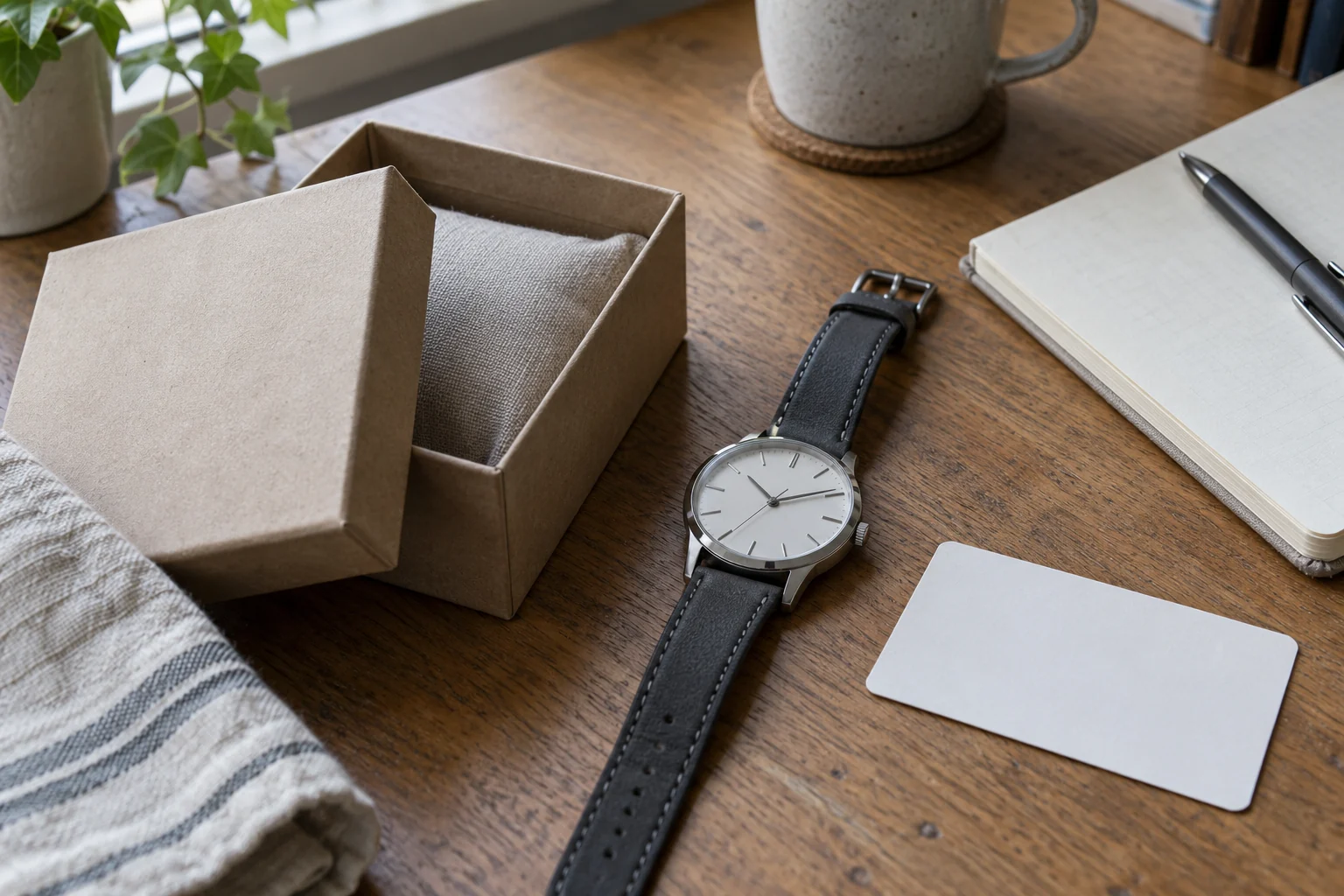
Start here
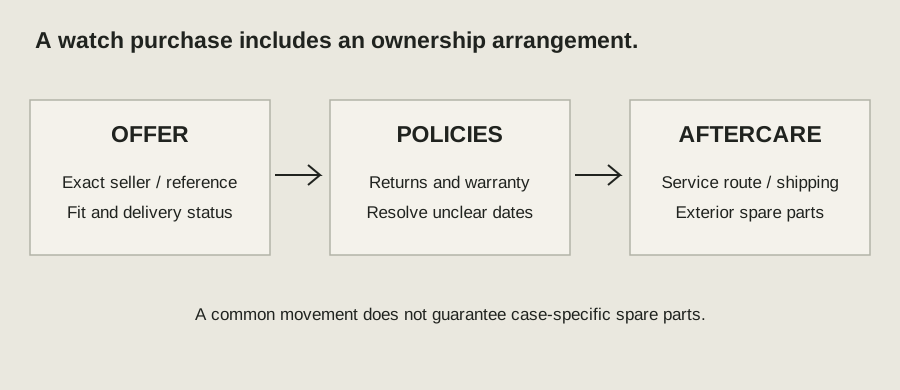
Evaluate the exact watch and seller, not the label “microbrand.” Confirm dimensions, movement, shipping status, written return terms, warranty scope and the route for future repairs. A common movement may simplify some servicing, but does not guarantee replacement crowns, crystals or bracelets. Save the policies that apply to your order and resolve unclear terms before paying.
As an Amazon Associate, we earn from qualifying purchases. How our links work ↗
1. Identify the seller and the exact offer
A microbrand is a broad informal description, not a quality grade or a warranty standard. Begin with the legal seller shown at checkout, the country of dispatch and the channel you are using. A brand's own store, an authorized retailer and a marketplace reseller may provide different return routes. The same watch photograph can appear in several offers without carrying the same ownership terms.
Write down the exact reference, dial variation and bracelet or strap option. Save the listing and the specifications on the day of purchase. If a listing says “new version,” ask which changes are included and whether the pictures show that version. This is particularly useful when a review concerns an earlier production batch.
Look for a working support contact and a clear business identity. Send one concise question that requires a specific answer, such as whether the bracelet includes half links. The usefulness and consistency of the response is evidence you can assess. A polished Instagram account or enthusiastic comment section does not substitute for that exchange.
2. Check fit beyond case diameter
Record diameter, lug-to-lug length, thickness and lug width. Ask whether the listed thickness includes the crystal and whether a bracelet's first links extend beyond the lugs. A modest diameter can still occupy a long distance across your wrist. Conversely, a case that looks large in a close photograph may fit comfortably if its lugs curve down.
Compare these numbers with a watch you already wear successfully. Use your existing watch as a reference rather than relying only on wrist circumference. Think about sleeve clearance, weight and how the clasp sits when you type. These are practical uses that a front-on dial photograph rarely shows.
Ask for a side view, a clasp view and an ordinary wrist photograph with the wearer's wrist size disclosed. None guarantees your comfort, but together they expose more of the design. If returning a sized bracelet becomes difficult under the seller's conditions, arrange a cautious fit check before removing protective material or making permanent changes.
3. Separate movement availability from complete-watch service
A movement name tells you something useful about the mechanism, but not everything about the finished watch. Ask for the exact caliber, the brand's stated timing standard and any adjustment conditions. A supplier specification and a brand's delivered-watch promise are different documents. Our NH35 versus Miyota 9015 guide explains why movement height and beat frequency do not determine the complete case or service arrangement.
Even a familiar movement sits inside a case with its own crown, stem fit, crystal, bezel, gaskets and dial. Replacing the mechanism alone will not supply a damaged crown or a proprietary bracelet link. Ask which exterior parts the brand expects to keep available and how a watchmaker can obtain them.
Do not assume that all local repair shops will accept the watch or offer the same work. If local service matters to you, ask your intended shop about that caliber and case before buying. Get a rough description of the service route rather than demanding a permanent price quotation for an unknown future repair.
4. Read warranty and returns as two separate agreements
A return period concerns changing your mind or assessing a purchase under specified conditions. A warranty concerns covered faults over a different period. Read both on the seller's actual site. Check when each clock starts, how to notify the seller, who pays shipping, whether import charges are recoverable and what condition the watch must be in.
A useful real example is Baltic's official documentation. Its returns and warranty page describes a 14-day notification window from delivery, another 14 days to send back an accepted return, and unused original packaging requirements. It describes a two-year warranty from shipment. The FAQ instead describes that warranty as beginning on the order date. We checked these pages on October 5, 2026. This discrepancy is a reason to ask the brand to confirm the start date in writing, especially for a preorder; it is not a reason to invent a harmonized policy.
For your chosen brand, make a small note with the notification deadline, return address, accepted condition and warranty contact. Save any written clarification. Do not assume that sizing, wearing or opening the case remains compatible with a change-of-mind return.
5. Use a ten-point pre-purchase checklist
The checklist below is deliberately about questions you can resolve. It does not assign a brand a numerical quality score. A box should be checked only when you can locate a written answer or have a satisfactory response from the seller. Mark unresolved points in your notes instead of treating uncertainty as a failure.
Three unknowns deserve particular attention: an unclear seller identity, a missing service route and an undefined delivery status. If any of these is essential to your purchase, wait for clarification. A discount is not a solution to an ownership problem you are unwilling to accept.
For a preorder, separate the estimated shipping month from a guaranteed delivery commitment. Ask what happens if production is delayed and how cancellation works before dispatch. Record the currency, payment schedule and any charges due on import. A preorder can be a reasonable choice, but the uncertainty should fit your budget and deadline.
Ten checks before paying
Use these checks alongside the detailed steps. Checkmarks last only for this open page.
Download checklist · TXT6. Send a short inquiry that can receive a clear answer
Use this template with the actual reference filled in. It is intended to make the conversation specific, not to demand that every small company offer an identical service model.
I am considering reference [reference] for delivery to [country]. Please confirm the warranty start date, covered faults and service location. Who pays shipping for an accepted warranty claim? Can you supply replacement crowns, crystals, gaskets and bracelet links for this reference? Please also confirm the return notification deadline, the condition required for a fit check, and whether this order is in stock or a preorder.
Read the response alongside the published terms. If the two conflict, ask which applies to your order and save the clarification. You can narrow the questions if the website already answers them clearly. Include your location because shipping and import arrangements can change the practical value of an otherwise generous policy.
Finally, decide whether the unresolved tradeoffs are acceptable to you. A watch may have excellent proportions and a straightforward movement but limited exterior-part availability. Another may cost more while offering a clearer repair route. This comparison gives you an ownership decision, rather than a ranking based on dial photographs and affiliate links.
Questions readers ask
Does a common movement mean every repair is easy?
No. The movement is only one part of the watch. Case-specific components and the service provider still matter.
Can I rely on a review of an earlier production version?
Use it as context, then verify the specifications, included accessories and policies for the version actually offered.
Are microbrands automatically better value?
No. Compare fit, construction, service and the complete delivered cost of the individual offer. The label alone establishes none of these.
Sources and how this guide was prepared
This is a researched explanation and a practical owner checklist. We reviewed the official sources below on October 5, 2026; we have not performed a laboratory test or claimed firsthand ownership of every device discussed. Worked examples and conceptual diagrams are labeled. Workspace and wearing scenes provide context; use model documentation for specifications and fit. Check the manual and support guidance for your exact model.
- Baltic: returns and warranty
- Baltic: FAQ, including warranty and return guidance
Found a model-specific exception or an instruction that has changed? Use the site's contact information and include the model and official source so the guide can be corrected.
Continue with the relevant guide
The next good question
Keep exploring.
 Read the story ↗
RZE UTD-8080: A Small Digital Watch Story With a Big Question
The interesting part is not another countdown timer. It is the idea that a newer watch need not make your older one obsolete.
 Read the story ↗
Seiko 4R36 Accuracy: How to Measure a Watch That Runs Fast or Slow
A repeatable seven-day check tells you more than one alarming reading.
 Read the story ↗
How to Set the Day and Date on a Seiko 4R36 or NH36 Watch
Get the calendar right by establishing morning and evening first.