Watches / A closer look
Seiko 4R36 Accuracy: How to Measure a Watch That Runs Fast or Slow
A repeatable seven-day check tells you more than one alarming reading.

Start here
To check Seiko 4R36 accuracy, compare the watch with the same reference clock at the same time each day, without resetting it between readings. Record whether it is ahead or behind, then calculate the change in that offset. A sudden change or repeated poor results deserves a service discussion, supported by your log.
As an Amazon Associate, we earn from qualifying purchases. How our links work ↗
What is the official 4R36 accuracy range?
Seiko lists a factory-adjusted daily rate of −35 to +45 seconds for the 4R36 in its current shared instruction manual, with the stated wrist-wearing temperature condition of 5–35°C. Those boundaries are useful context, not a promise that every measurement in every position will fit inside them. Check the manual for your exact watch reference before comparing results. Source: Seiko specifications.
The number on a seller's page may describe a different movement or the seller's own regulation standard. Do not silently replace a 4R36 specification with an NH36 number. If the caseback and paperwork disagree, record the full watch reference and ask the seller to identify the fitted movement. You do not need to open the watch to begin this conversation.
A practical question is whether the watch behaves consistently enough for your routine. A predictable gain that you correct occasionally is different from a watch that alternates between moderate gain and unexplained large losses. The second pattern gives a technician different information, even if both owners describe their watches as inaccurate.
Total offset and daily rate are different measurements
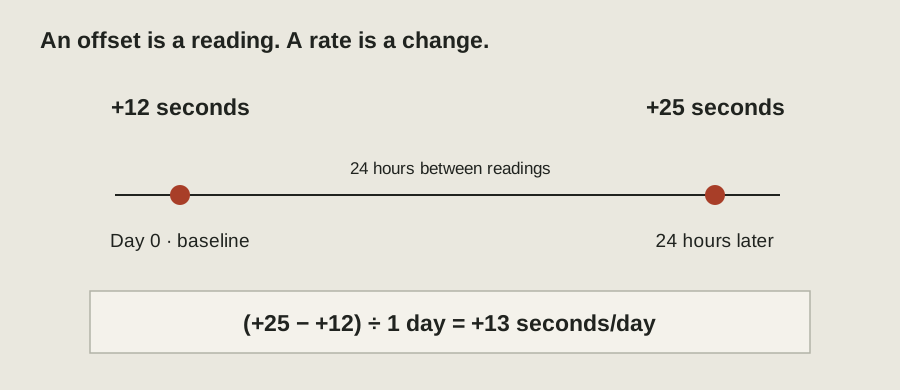
Offset is how far the displayed time differs from the reference right now. Use a plus sign when the watch is ahead and a minus sign when it is behind. Daily rate is how much that offset changed over a measured interval, expressed per 24 hours.
For example, a watch that was 12 seconds ahead yesterday and is 25 seconds ahead today gained 13 seconds over that day. It did not gain 25 seconds in the latest interval. If it starts 20 seconds behind and finishes 5 seconds behind, it gained 15 seconds even though it still shows an earlier time than the reference. These are teaching examples, not measurements of a particular Seiko.
Recording the signs prevents a common error: calling every negative reading a loss during the interval. If you missed your usual checking time, write the actual elapsed hours. A 36-hour change should not be treated as a 24-hour change. The calculator below handles that difference.
Build a useful seven-day record
Pick a time you can keep, such as after breakfast. Use one stable reference throughout; switching between devices introduces another possible difference. Make the seconds display easy to compare. Read in a calm moment rather than trying to estimate while walking or while the reference page is still loading.
- Start with a running watch. Follow the model's winding and crown instructions. Note your preparation instead of assuming that a moving seconds hand proves a full reserve.
- Record a baseline. You may synchronize once, or simply record the starting offset. Neither approach requires the first reading to be zero.
- Check at the same time daily. Write the signed offset and the real observation time. Leave the watch running between checks.
- Describe the routine. Note approximate wear time, whether the day was mostly desk work, and the overnight resting position.
- Record interruptions. If you reset the time, stop the seconds hand, or the watch stops, end that interval. Begin a new baseline rather than blending the readings.
Seiko recommends judging mechanical accuracy across roughly a week because wearing conditions and winding state affect the result. Its accuracy guidance also explains positional and temperature effects. Source: Seiko mechanical accuracy guidance. Our log is an owner-level record, not a substitute for the manufacturer's controlled measurement procedure.
Calculate the change, then keep a record
Enter positive offsets when ahead, negative offsets when behind. This is an arithmetic tool, not a service verdict.
Download blank timing log · CSVRead the pattern before trying to fix it
Compare each day's change, then calculate the overall change between the first and last valid readings. Seven dated readings usually contain six intervals; if you want seven complete 24-hour intervals, include the starting baseline plus seven follow-up readings. Count the elapsed time instead of dividing automatically by the number of rows.
| Pattern | Useful next check |
|---|---|
| Similar gain each day | Keep the routine consistent and compare the average with the exact specification. |
| Loss mainly after low-activity days | Record winding preparation and whether the watch also stops. |
| Large isolated jump | Check for a reset, reading error, stop, impact or other event. |
| Persistent abrupt change from its old behavior | Save the log and discuss inspection with the service provider. |
Change one variable at a time if you want to explore your routine. You could keep wear time similar and compare two overnight positions across separate periods. Do not assume dial-up will always slow a watch or crown-down will always speed it up. The useful result is what your watch repeatedly does, not what another owner's watch does.
When to stop experimenting and contact service
If the watch repeatedly performs poorly relative to its applicable guidance under ordinary, documented use, ask the retailer or service center to assess it. A sudden major change, stopping despite appropriate winding, moisture under the crystal, or an unusual crown feel is more informative than a single daily average.
Seiko notes that strong magnetic exposure can affect rate and recommends consulting the retailer when demagnetizing or repair is needed. That does not make magnetism the explanation for every fast watch. A timing log alone cannot identify a magnetized hairspring, damaged component or lubrication problem. Source: Seiko accuracy guidance.
Send a concise message: watch reference, approximate purchase date, normal routine, start and end offsets, elapsed time, and any recent change. Ask whether the inspection includes rate assessment, power-reserve concerns and the relevant warranty procedure. Avoid opening the case or moving a regulator just to see what happens; doing so changes the problem you are trying to document.
What should you buy, if anything?
You can do this first check with the watch, a dependable time reference and a notebook. A timing machine is not necessary to learn whether the displayed time drifts consistently. Its short readings answer a different question and require suitable setup and interpretation.
If your actual need is to pick up a watch after several unworn days without resetting it, think about the movement type before spending on accessories. Our automatic versus solar guide explains that routine. If the calendar is wrong but the time remains steady, use the day and date setting tutorial. Buying another watch is not the first step in either diagnosis.
Questions readers ask
Is +20 seconds a day automatically a fault?
Not by itself. Compare a consistent multi-day record with the exact movement and watch guidance, including the stated conditions. A sudden change from earlier behavior is also worth documenting.
Should I reset the watch every morning?
Not during the same measurement run. Resetting removes the continuous offset history. If you reset it, mark the interruption and start a new interval.
Sources and how this guide was prepared
This is a researched explanation and a practical owner checklist. We reviewed the official sources below on October 5, 2026; we have not performed a laboratory test or claimed firsthand ownership of every device discussed. Worked examples and conceptual diagrams are labeled. Workspace and wearing scenes provide context; use model documentation for specifications and fit. Check the manual and support guidance for your exact model.
- Seiko: 4R36 specifications
- Seiko: mechanical accuracy and magnetism
- Seiko: winding the mainspring
Found a model-specific exception or an instruction that has changed? Use the site's contact information and include the model and official source so the guide can be corrected.
Continue with the relevant guide
The next good question
Keep exploring.
 Read the story ↗
How to Set the Day and Date on a Seiko 4R36 or NH36 Watch
Get the calendar right by establishing morning and evening first.
 Read the story ↗
NH36 vs 4R36: Accuracy, Specifications and Buying Checks
The numbers only help when you keep their conditions attached. Understand the movement names, read accuracy claims, and choose between a finished watch and a project.
 Read the story ↗
RZE UTD-8080: A Small Digital Watch Story With a Big Question
The interesting part is not another countdown timer. It is the idea that a newer watch need not make your older one obsolete.