Watches / A closer look
Why Does My Automatic Watch Stop Overnight? A Practical Checklist
A quiet day can leave less energy than you expect. Start with a controlled observation before buying a winder or assuming the movement is broken.
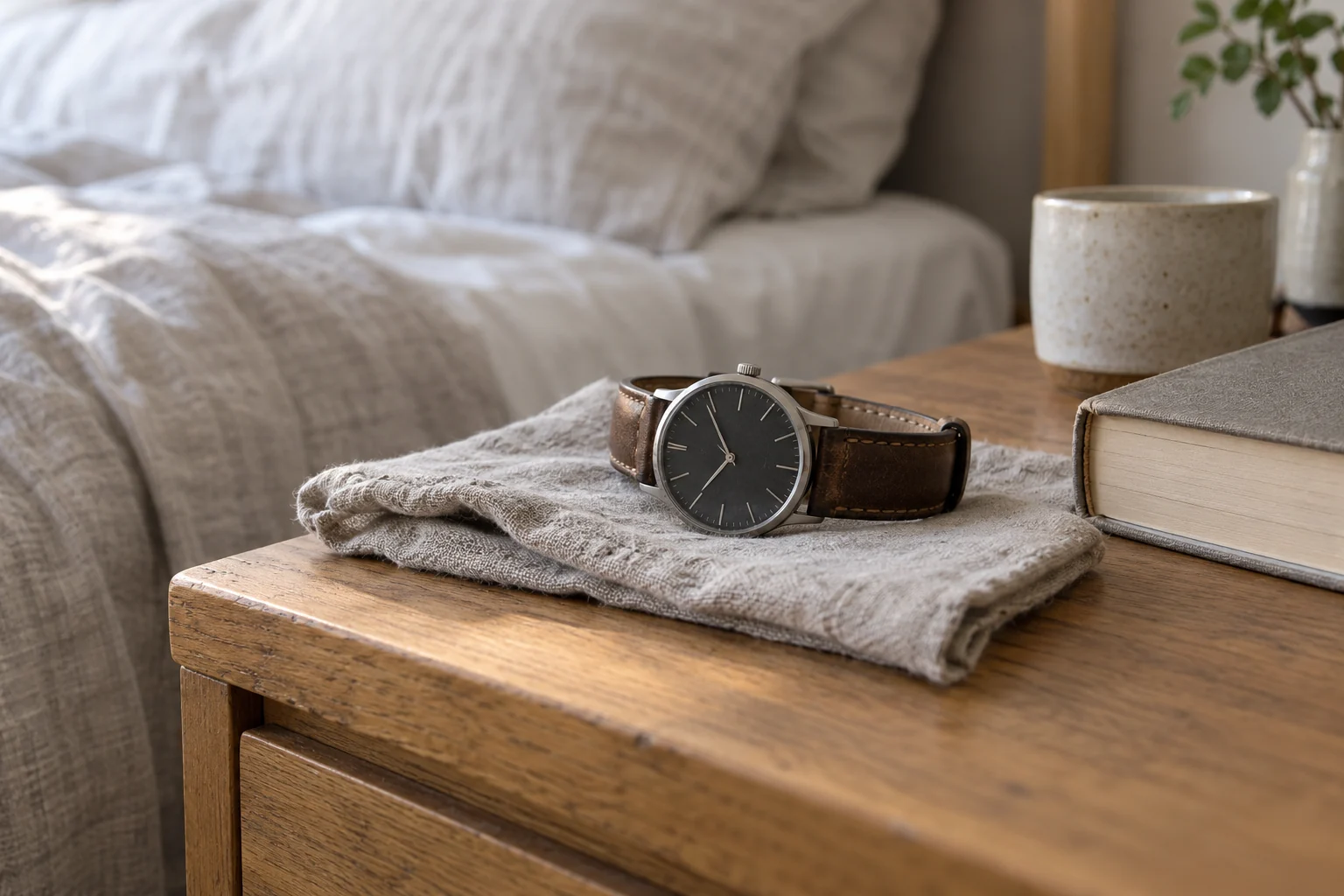
Start here
An automatic watch can stop overnight because it was not sufficiently wound when you took it off. A quoted power reserve describes specified winding and observation conditions; it does not promise that every day of wear fills the mainspring. Confirm the exact movement and winding instructions, establish a documented starting condition, and record whether the stop repeats. A sudden change, damage, moisture or abnormal crown resistance calls for professional assessment.
As an Amazon Associate, we earn from qualifying purchases. How our links work ↗
1. Confirm that the watch actually stopped
Start by comparing the seconds hand with a reliable reference. A watch that is several minutes behind may have stopped and restarted while you picked it up, but it may also simply be losing time. Those are different observations. Write down what the seconds hand was doing before you moved the watch, the displayed time, and the actual time. Avoid immediately resetting it and losing the evidence.
Also establish whether the watch is mechanical. A light-powered quartz watch, a battery-powered watch and an automatic mechanical watch store energy differently. A seconds hand that advances unusually can be a model-specific warning rather than an automatic winding problem. Read the case-back reference and the matching instruction manual. If you bought a modified watch, ask the builder which movement was installed; the dial name alone may not identify it.
For a mechanical watch that continues ticking but gains or loses time, use our signed-offset timing guide. For one that stops, keep the following record focused on duration and starting conditions.
2. Understand full power reserve versus the energy left today
A power-reserve specification is an operating duration from a specified wound condition. It is not a count of hours you have worn the watch. For example, the official Seiko 4R-family instructions describe automatic and manual winding and about 41 hours of operation when fully wound. That figure does not establish that your particular workday achieved full winding.
A practical example: you put on a watch that stopped yesterday, wear it during a mostly seated afternoon, then leave it overnight. That is a different starting point from winding it according to its manual before recording the time it is set down. Both observations can be true without contradicting the manufacturer's reserve figure.
Keep the distinction visible in your notes: “after ordinary wear” and “after the manual's recommended preparation.” Do not label either observation a laboratory reserve measurement. Your activity, winding method, previous state and measurement timing remain uncontrolled. The purpose of this home check is to establish a repeatable pattern that helps you decide what to do next.
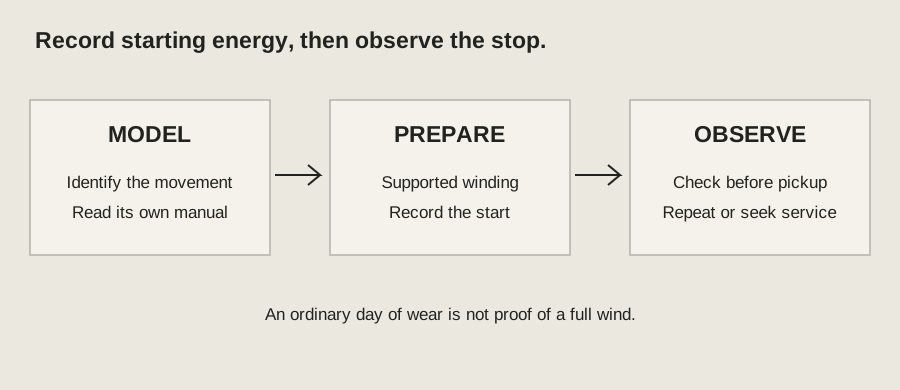
Your overnight observation record
Use these checks alongside the detailed steps. Checkmarks last only for this open page.
Download checklist · TXT3. Use only the winding procedure supported by your watch
Some automatic movements permit hand winding; others do not. Even where the movement allows it, a screw-down crown must be released correctly before the operating position is available. Find the manual for the complete watch, including its crown arrangement. Do not apply a turn count from a different movement or assume that every crown position winds the spring.
For the Seiko family cited above, the instructions specify slow clockwise crown winding in the normal operating position. Treat this as a model example, not a rule for all watches. Follow the actual manual's preparation guidance, then return the crown to its normal secured position. Do not use strong shaking as a substitute or attempt to force unfamiliar resistance.
If the crown feels gritty, will not engage normally or behaves differently after a knock, stop the home check. Describe the symptom to the seller or watchmaker. Continuing to manipulate it can make the eventual service discussion less straightforward. A functioning winding action also does not prove the movement is healthy; it only establishes one part of the observation.
4. Make one useful overnight record
Choose an evening when you can check the watch again without interrupting its rest. Record the watch reference, the preparation method, the time you finish preparing it and the time you put it down. Set it in a stable, dry place where it will not be bumped. You do not need a special display box, an improvised magnetic test or an expensive tool.
Before touching it in the morning, note whether it is running. If stopped, photograph the dial and note the actual time. The difference between the last confirmed running observation and the first confirmed stopped observation gives a window, not an exact stopping time. The dial indication can help, but a date transition or ambiguous twelve-hour reading can make it misleading.
| Record | Useful wording |
|---|---|
| Starting condition | Prepared using the matching manual; method recorded |
| Last confirmed running | 10:15 p.m., before setting down |
| Morning observation | 7:30 a.m., seconds hand stationary before pickup |
| Interpretation | Stopped during this observation window; exact stop unconfirmed |
These times are an example worksheet entry, not measurements of a specific watch. Repeat under the same preparation conditions if there are no damage warnings. Changing the winding method, storage location and watch position simultaneously makes comparisons harder to interpret.
5. Decide what the pattern supports
If the watch runs through the night after the documented preparation but not after ordinary wear, insufficient energy at bedtime becomes a plausible explanation. You can adapt your routine to the manufacturer's instructions. That does not require declaring your movement defective or buying a winder. Compare a few ordinary days with the prepared observation before changing equipment.
If it repeatedly stops soon after the supported preparation, send the record to the seller or a qualified watchmaker. Avoid promising yourself a specific diagnosis. Winding efficiency, the mainspring, lubrication, damage and other internal conditions cannot be distinguished reliably by a photograph of the stopped dial. A short repeatable duration is a reason to request assessment, not proof of a particular failed part.
A stop accompanied by visible moisture, a recent impact or unusual crown behavior should bypass routine experiments. Include those facts in the first message. Do not open the case, apply household lubricant or try to “free” the mechanism. For a watch within its warranty period, ask about the approved service route before someone else works on it.
6. A watch winder is a convenience decision
A winder can keep a compatible automatic watch moving between wears, but it does not establish why an overnight stop occurred. If the watch has a mechanical fault, changing its storage routine may only obscure the symptom. If it was simply underwound, a manual-approved winding routine may already solve the practical problem.
Before buying one, ask whether continuous operation actually benefits your use. A simple time-and-date watch worn regularly can be easy to reset. A watch with more involved calendar functions may make continuous running more convenient, but its winding direction and operating recommendations still matter. The presence of multiple watches in a collection does not make a winder mandatory.
For a service inquiry, send five useful details together: the reference, when the problem began, the preparation method, the repeated observation windows and any impact or moisture history. Ask what additional evidence the service team needs and who handles shipping. This is more useful than saying “the advertised reserve is wrong” based on an unrecorded afternoon of wear.
Questions readers ask
Does wearing an automatic watch all day guarantee a full wind?
No. Duration on the wrist is not a measurement of stored energy. Activity, starting condition and movement design matter; follow the exact manual.
Can I use the stopped dial to calculate exact power reserve?
Only if the starting state and stop time are established adequately. A home overnight observation usually supports a time window rather than a precise laboratory result.
Should I shake it harder if it will not start?
No. Follow the supported winding procedure. Abnormal behavior or resistance should be discussed with the seller or watchmaker.
Sources and how this guide was prepared
This is a researched explanation and a practical owner checklist. We reviewed the official sources below on October 5, 2026; we have not performed a laboratory test or claimed firsthand ownership of every device discussed. Worked examples and conceptual diagrams are labeled. Workspace and wearing scenes provide context; use model documentation for specifications and fit. Check the manual and support guidance for your exact model.
- Seiko: automatic and manual winding instructions for the 4R family
Found a model-specific exception or an instruction that has changed? Use the site's contact information and include the model and official source so the guide can be corrected.
Continue with the relevant guide
The next good question
Keep exploring.
 Read the story ↗
Best Automatic Watches Under $200: A Budget-Honest Buying Guide
A smaller shortlist. A complete bill. A watch you will actually wear.
 Read the story ↗
Best Small Automatic Watches Under $300: A Fit-First Shortlist
For a smaller-wrist automatic under $300, prioritize case diameter, lug-to-lug length, thickness and lug shape before movement names or brand prestige. A compact watch with a short lug span can wear smaller than its diameter suggests. Prices and availability change, so treat this as a measurement-led shortlist and confirm exact dimensions on the current listing.
 Read the story ↗
RZE UTD-8080: A Small Digital Watch Story With a Big Question
The interesting part is not another countdown timer. It is the idea that a newer watch need not make your older one obsolete.