Watches / A closer look
NH35 vs Miyota 9015: What Changes in Daily Use?
Compare the movement, then judge the watch built around it.

Start here
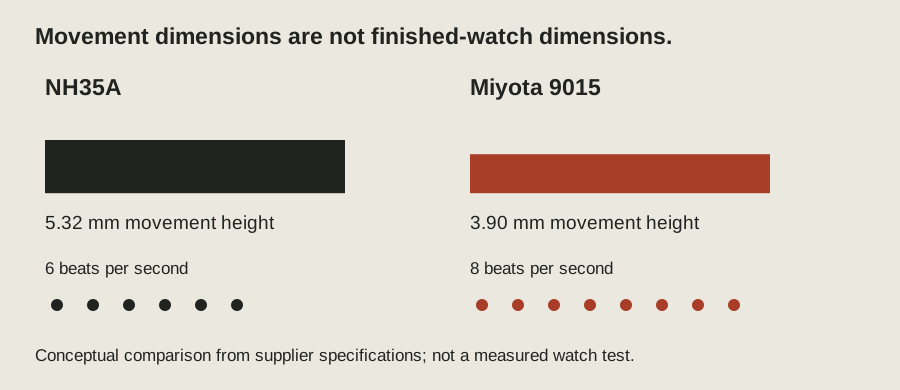
The Miyota 9015 is thinner and runs at a higher frequency than the NH35, with a narrower published accuracy range. Both offer automatic and manual winding, a date and stop-seconds setting. Those differences matter, but they do not guarantee that a 9015 watch will fit better, last longer or keep better time than a particular NH35 watch.
As an Amazon Associate, we earn from qualifying purchases. How our links work ↗
Start with specifications, not movement rankings
The NH35 is part of TMI's NH3 mechanical family. The 9015 belongs to Miyota's Premium Automatic range. Both are widely used by watch brands, but the movement supplier is only one participant in the finished product. Case manufacture, assembly, adjustment and after-sales support are separate questions.
| Specification | TMI NH35A | Miyota 9015 |
|---|---|---|
| Movement height | 5.32 mm | 3.90 mm |
| Vibrations per hour | 21,600 | 28,800 |
| Published reserve | More than 41 hours, fully wound | Approximately 42 hours |
| Published rate | −20 to +40 seconds/day, specified static conditions | −10 to +30 seconds/day |
| Winding and setting | Automatic, hand-winding, stop-seconds | Automatic, hand-winding, stop-seconds |
| Calendar | Date | Date |
Sources: TMI NH35 specification drawing, TMI NH3 technical guide, and Miyota 9015 product specifications. Supplier measurement conditions differ; these are not results from a shared side-by-side test.
The seconds hand looks different; accuracy is another question
Dividing the stated hourly frequency by 3,600 gives six beats per second for the NH35 and eight for the 9015. That arithmetic explains why a suitable close view of the 9015 seconds hand can look a little smoother. It does not mean either seconds hand moves in a literally continuous sweep.
Whether you notice that difference depends on the hand shape, lighting, distance and how much attention you pay to the watch. If you mainly glance at it for the time, the effect may be minor. If you enjoy watching the movement, it may be part of the appeal. Neither response is wrong; they simply place different value on the same visible characteristic.
Do not convert the beat-rate difference into a percentage improvement in reliability or timekeeping. Frequency is one design characteristic. The rate of the finished watch, and whether that rate remains consistent in your use, must be measured separately. A watch comparison that shows only two seconds hands has not measured long-term accuracy.
A thinner movement creates an opportunity, not a fit guarantee
The listed movement-height difference is 1.42 mm. That creates room for a thinner design, but you cannot subtract 1.42 mm from an NH35 watch's case thickness and predict the thickness of a 9015 watch. The dial, hands, movement holder, crystal, caseback and construction requirements also occupy space.
Compare actual finished-watch dimensions. Ask whether thickness includes the highest point of the crystal. Look at side-view photographs and note the lug shape. A thick but well-shaped case can sit comfortably, while a nominally slim watch with long straight lugs may project beyond your wrist.
A useful shopping comparison has two levels: the supplier's movement drawing and the brand's finished-watch measurements. If a listing praises “ultra-thin movement” but does not provide total thickness or lug-to-lug length, the most useful follow-up is a request for those measurements. A movement label does not answer whether the watch will slide under your sleeve.
Your finished-watch buying checklist
Use these checks alongside the detailed steps. Checkmarks last only for this open page.
Download checklist · TXTCompare a stated adjustment standard with your own timing record
The 9015's published range is narrower than the NH35's. That is a legitimate specification difference. It is still not evidence that every individual 9015 watch will outperform every individual NH35 watch on the wrist. Ask whether the watch brand provides its own documented adjustment or inspection standard and what conditions it uses.
Before buying, distinguish three statements: the movement supplier's specification, the brand's promised finished-watch rate, and an owner's measurement. A seller saying that a sample achieved a small daily gain does not turn that result into a warranty for every watch it ships.
After buying, use the same reference and routine to record offset over several days. Note any reset or stop. Our timing-log guide explains the arithmetic, although its 4R36 specification section does not apply to an NH35 or 9015. That distinction lets you reuse a method without borrowing the wrong acceptance range.
Reserve and winding should match your weekly routine
The published reserves are in a similar range; neither specification suggests that you can routinely leave the watch unworn for an entire weekend and expect it to be running on Monday. Actual running time starts from the energy stored when you put it down, which may be below a full wind.
Both movements support manual winding. That can be useful after a break in wear, but the finished watch's crown action and operating instructions still matter. Read those before deciding how to restart and set it. Do not confuse a crown that has been released from screw-down threads with a crown that has already reached its time-setting click.
Think about use rather than buying a winder automatically. For one daily watch, a brief setting routine may be acceptable. For someone who rotates watches and dislikes calendar setting, a different movement type may suit the routine better. A winder does not cure an underlying reserve or calendar fault.
How should you judge rotor sound?
A rotor is a moving part, so movement inside an automatic watch is not inherently surprising. The case construction and the way you move the watch can change what reaches your ear. An online audio clip can also exaggerate it because microphone distance and recording gain differ.
When evaluating a particular watch, compare ordinary wearing sounds with grinding, scraping or a new noise that accompanies stopping. A sound description alone cannot diagnose the mechanism. Ask the brand what is expected for its reference and whether the behavior warrants inspection. If quietness matters to you, try that actual watch in a quiet room or check the return policy before purchase.
Avoid using “silent” or “noisy” as universal verdicts about either movement. This guide has not recorded matched watch samples and cannot provide a measured noise ranking. It can give you a better question to ask: is the sound normal for this finished watch, and does it bother you in your real setting?
Choose the complete watch and the support behind it
Choose a 9015-based watch when the finished design makes meaningful use of its characteristics and meets your needs. Choose an NH35-based watch when its overall package offers the fit, legibility, construction and support you want at an acceptable price. A premium movement label cannot compensate for the wrong dimensions or unclear after-sales terms.
- Write down total thickness, diameter and lug-to-lug length for both watches.
- Ask for the brand's actual adjustment standard, rather than relying on movement marketing.
- Confirm who handles warranty work and where the watch must be sent.
- Ask how crystal, crown, gasket and other case-specific replacements are supplied.
- Read the return terms before choosing a watch you cannot try on.
Finally, compare the price difference with what changes beyond the movement. Better case finishing, a more useful bracelet or a clear local service route may matter more in daily use. The strongest choice is the watch whose complete specification and ownership plan fit you, not the movement that wins the most isolated table rows.
Questions readers ask
Is the Miyota 9015 automatically more accurate?
Its published range is narrower, but actual finished-watch performance depends on adjustment and conditions. Compare the applicable brand promise and a consistent timing record.
Does an NH35 show the weekday?
NH35 is date-only. NH36 is the related day-date movement; confirm the fitted caliber rather than assuming from the case design.
Sources and how this guide was prepared
This is a researched explanation and a practical owner checklist. We reviewed the official sources below on October 5, 2026; we have not performed a laboratory test or claimed firsthand ownership of every device discussed. Worked examples and conceptual diagrams are labeled. Workspace and wearing scenes provide context; use model documentation for specifications and fit. Check the manual and support guidance for your exact model.
- TMI NH35 specification drawing
- TMI NH3 technical guide, specifications
- Miyota 9015 official specifications
Found a model-specific exception or an instruction that has changed? Use the site's contact information and include the model and official source so the guide can be corrected.
Continue with the relevant guide
The next good question
Keep exploring.
 Read the story ↗
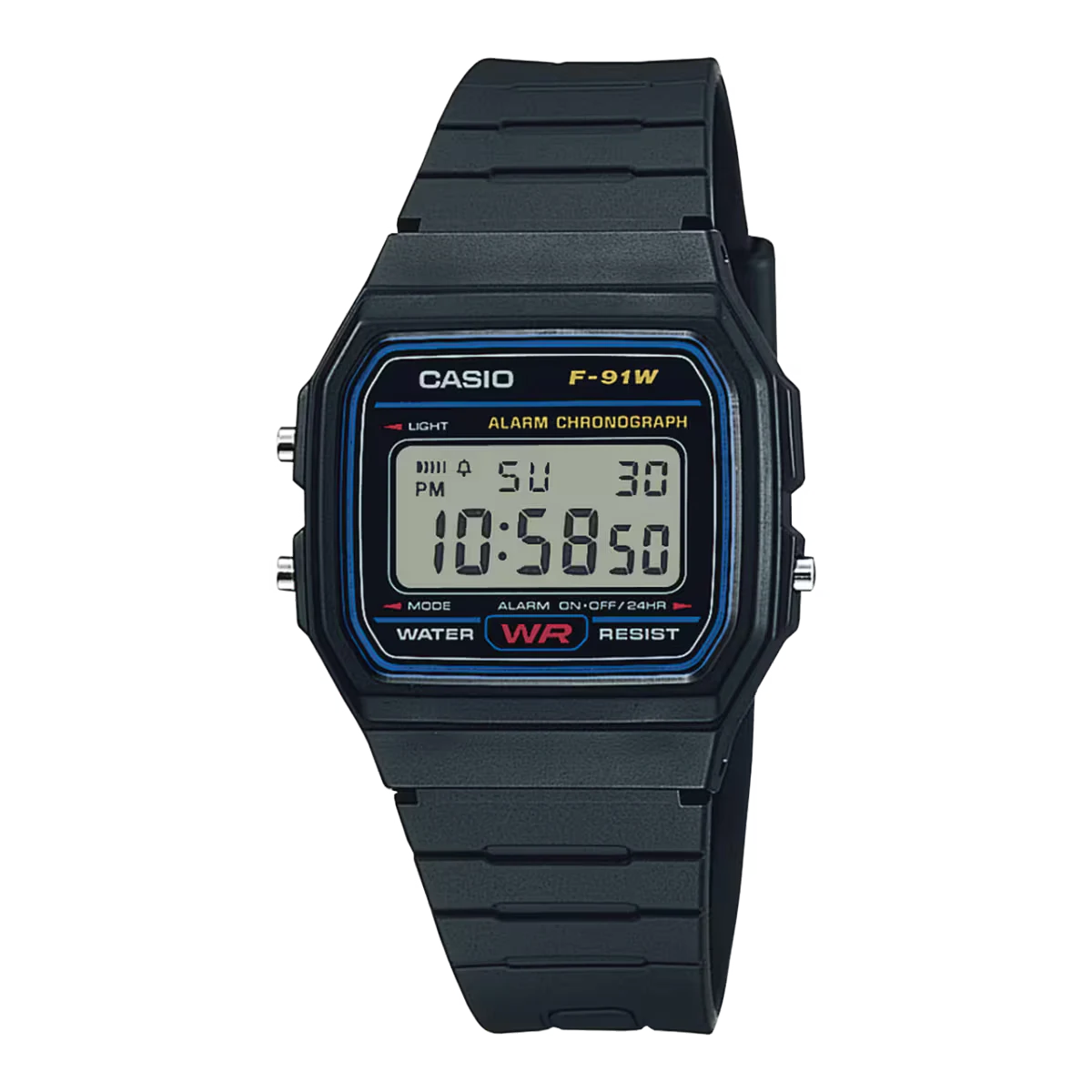
Casio F-91W vs A158WA vs AE-1200 vs A168: Which One Fits?
Compare four classic Casio digital watches by size, display, everyday features and use case, with official specifications and clear trade-offs.
 Read the story ↗
NH35 vs Miyota 8215: Accuracy, Hacking and the Watch You Buy
Start with the version. Finish with the complete watch.
 Read the story ↗
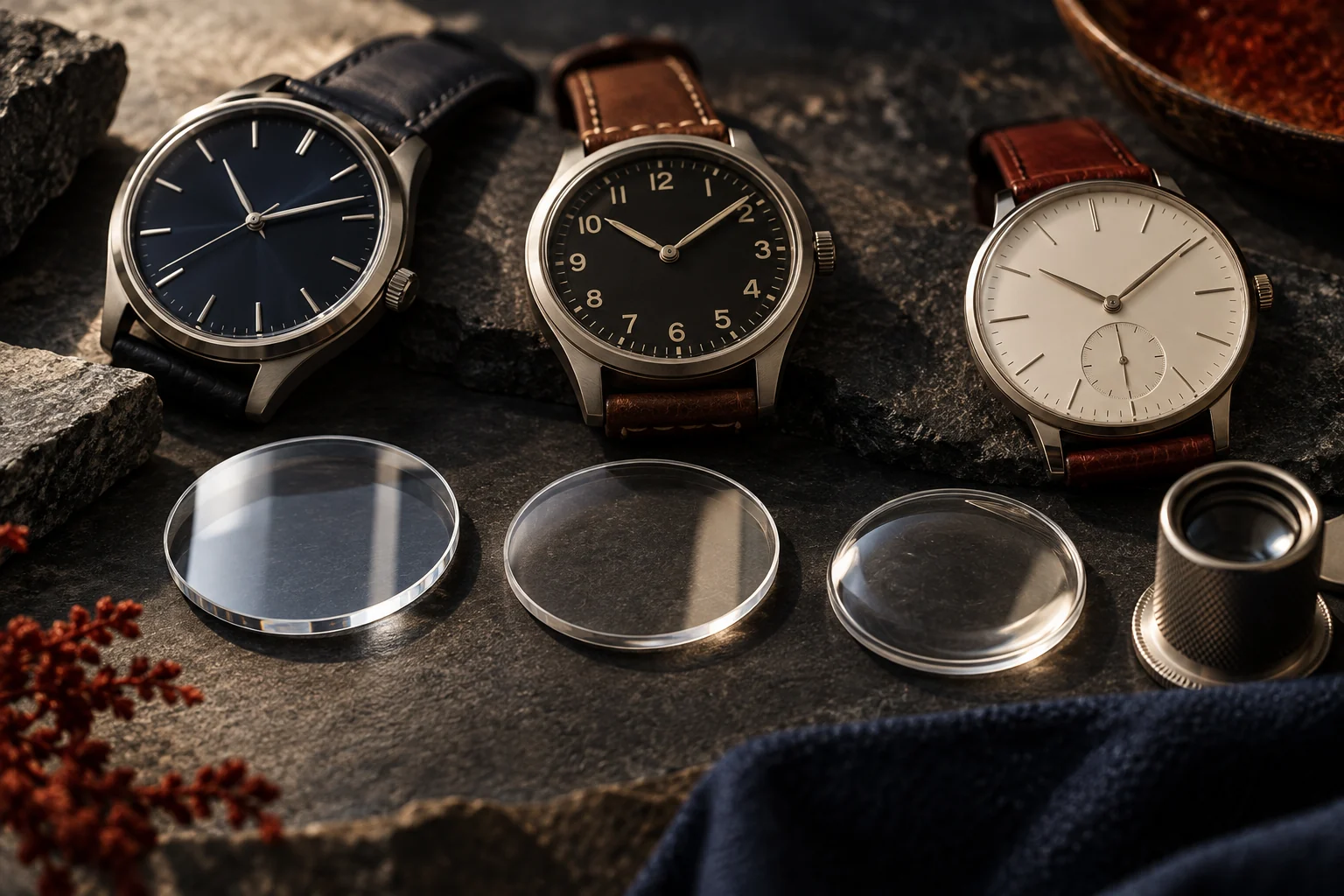
Sapphire vs Mineral vs Acrylic Watch Crystal: The Real Tradeoffs
Scratch resistance is only one part of a watch crystal. Here is how sapphire, mineral glass, and acrylic differ in daily use and repair.