Watches / A closer look
NH35 vs Miyota 8215: Accuracy, Hacking and the Watch You Buy
Start with the version. Finish with the complete watch.
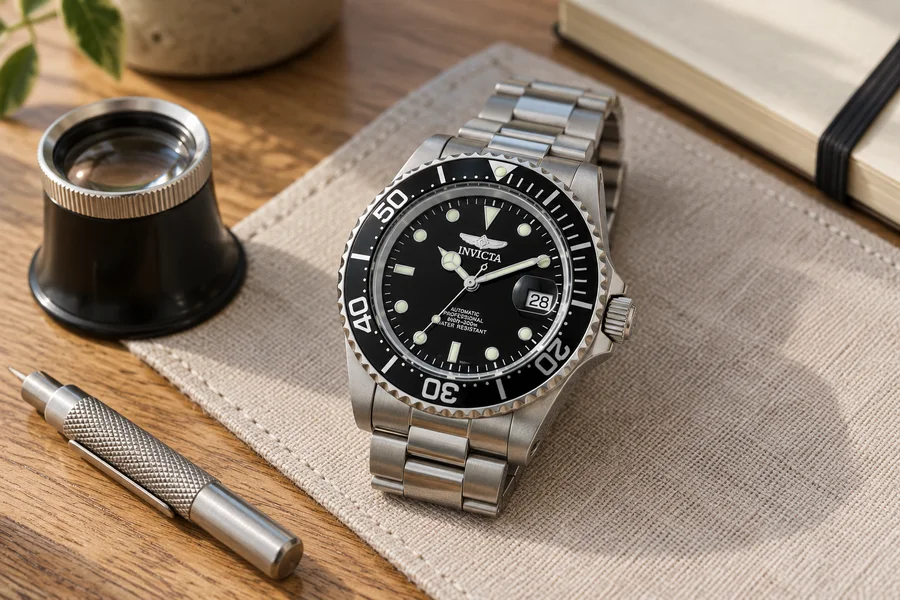
Start here
Neither movement name guarantees the better finished watch. Both support automatic and hand winding, and Miyota’s current 8215 page now lists stop-seconds, so verify the actual version rather than calling every 8215 non-hacking. Compare the watch’s fit, regulation promise, seller and service route.
As an Amazon Associate, we earn from qualifying purchases. How our links work ↗
The useful details, in one place.
Compare the published details
| Feature | NH35 | Miyota 8215 |
|---|---|---|
| Beat rate | 21,600 vph | 21,600 vph |
| Hand winding | Supported | Supported |
| Stop-seconds | Listed by TMI | Listed on current Miyota page; check stock version |
| Reserve class | More than 41 hours, stated conditions | Approximately 42 hours |
| Movement height | 5.32mm | 5.67mm |
| Jewels | 24 | 21 |
| Replacement fit | Use exact casing drawings | Not an assumed NH35 drop-in |
Manufacturer information checked October 15, 2026. These are published claims, not our sample measurements. Match the exact model, revision and instructions.
The short answer: choose the complete watch, then check its movement
If you are comparing an NH35 watch with a Miyota 8215 watch, start with the watch you will actually wear. The movement matters, but so do the case, dial, bracelet, assembly, seller and service route. A dependable automatic inside an uncomfortable case is still an uncomfortable watch. Neither caliber name proves that the finished product has been regulated well, assembled carefully or pressure tested. The useful comparison is about ownership and compatibility, not a contest in which one familiar name wins every category.
The most important correction is about hacking, or stop-seconds. Miyota's current 8215 product page lists a stop-second device. Older descriptions commonly say the 8215 does not hack, so you need to verify the version in the actual watch being sold. This researched guide uses current manufacturer information and separates it from older stock and general ownership advice. We have not run a timing trial, measured winding efficiency or opened watches for this comparison. The workbench scenes are illustrations, not records of a bench test.
Get the names and evidence straight
NH35 is part of Time Module's NH mechanical movement lineup. It is widely associated with the broader Seiko movement family, but the caliber name should not be treated as proof that the finished watch is a Seiko-branded product. Miyota supplies the 8215 as a separate standard automatic movement. Ask the watch seller for the actual caliber identification and relevant specification, particularly when a product page groups several movement options under one listing. A familiar keyword in a title is weaker evidence than a clear model-specific description.
For this comparison, the primary references are Time Module's NH lineup, its NH35 documentation and the current Miyota 8215 page. Documents can be revised, and finished-watch brands can make their own promises. Keep those layers separate. An instruction for a bare movement is not permission to ignore the case manufacturer's crown instructions. Likewise, a bare movement's dimensional drawing does not guarantee that a third-party case advertised with a broad compatibility claim will fit.
What both movements offer in ordinary use
Both are automatic mechanical movements that also support hand winding. Both provide three central hands and a date arrangement, with a nominal beat rate of 21,600 vibrations per hour in the manufacturer information. In plain language, their seconds hands move in several small steps each second rather than the familiar one-step-per-second action of many quartz watches. That behavior is part of the appeal, but it is not evidence that either watch keeps more accurate time than an ordinary quartz alternative.
An automatic winds through wrist movement; it does not create unlimited stored energy. If the watch is worn briefly, kept still or rotated with several other watches, it can stop. Hand winding can help establish a sensible starting condition when the manufacturer's instructions permit it. Follow the finished watch's manual, including how to release and secure a screw-down crown. Avoid substituting an arbitrary number of crown turns from an online comment for the instruction that applies to your watch.
The hacking question has a version problem
Hacking means the seconds hand stops when the crown is pulled to the appropriate time-setting position. It is convenient when you want to synchronize the watch to a reference. Time Module lists stop-seconds for the NH35, and Miyota's current 8215 page does too. Therefore, a new comparison that simply labels every 8215 non-hacking is incomplete. The right buying question is whether the specific watch, batch or stock item offered by the seller has the feature you expect.
Older watches and older listings still exist. Ask the brand or seller directly if synchronization matters to you, and keep the answer with the order details. During the return window, follow the model's crown procedure and check the behavior gently. Do not try to force a non-hacking example to stop by applying backward pressure to the hands. A missing feature in older stock is a version-identification issue; it is not automatically evidence of a broken movement or a dishonest manufacturer specification.
Accuracy claims need a document and a condition
Miyota currently publishes a minus-twenty to plus-forty seconds-per-day range for the 8215. Treat that as a stated specification, not a prediction that your watch will gain exactly a particular number of seconds. For the NH35, match the seller's accuracy statement to the applicable Time Module document and test conditions rather than combining ranges from different online summaries. Temperature, position, state of wind and the finished watch's regulation can affect the result. A single caliber name does not supply all that information.
The practical distinction is between an allowed range, a brief instrument reading and an average over normal wearing. Those are different kinds of evidence. A watch may look good in one resting position and behave differently across a week on your wrist. Conversely, a modest published tolerance does not mean every example performs near its limit. Ask what the brand guarantees for the finished watch, how it checks that guarantee and what remedy applies if the delivered watch falls outside it.
A simple timing log is more useful than one impressive screenshot
Set the watch against a consistent time reference and record the signed difference at roughly the same time each day. Write plus for a watch that is ahead and minus for one that is behind. Keep wearing and overnight storage reasonably consistent while you establish a baseline. A multi-day observation is easier to interpret than a photograph of a timegrapher taken immediately after winding. It also reflects the ownership question you probably care about: how often will you want to reset this watch?
For example, a watch that moves from zero to plus-forty-two seconds over three complete days has averaged plus-fourteen seconds per day over that interval. This is an arithmetic example, not a result from either movement. If you reset the hands during the interval, begin a new record. Note changes in wearing or storage instead of hiding inconvenient days. Our automatic-watch accuracy guide describes the process in more detail without pretending that a home log is a controlled laboratory test.
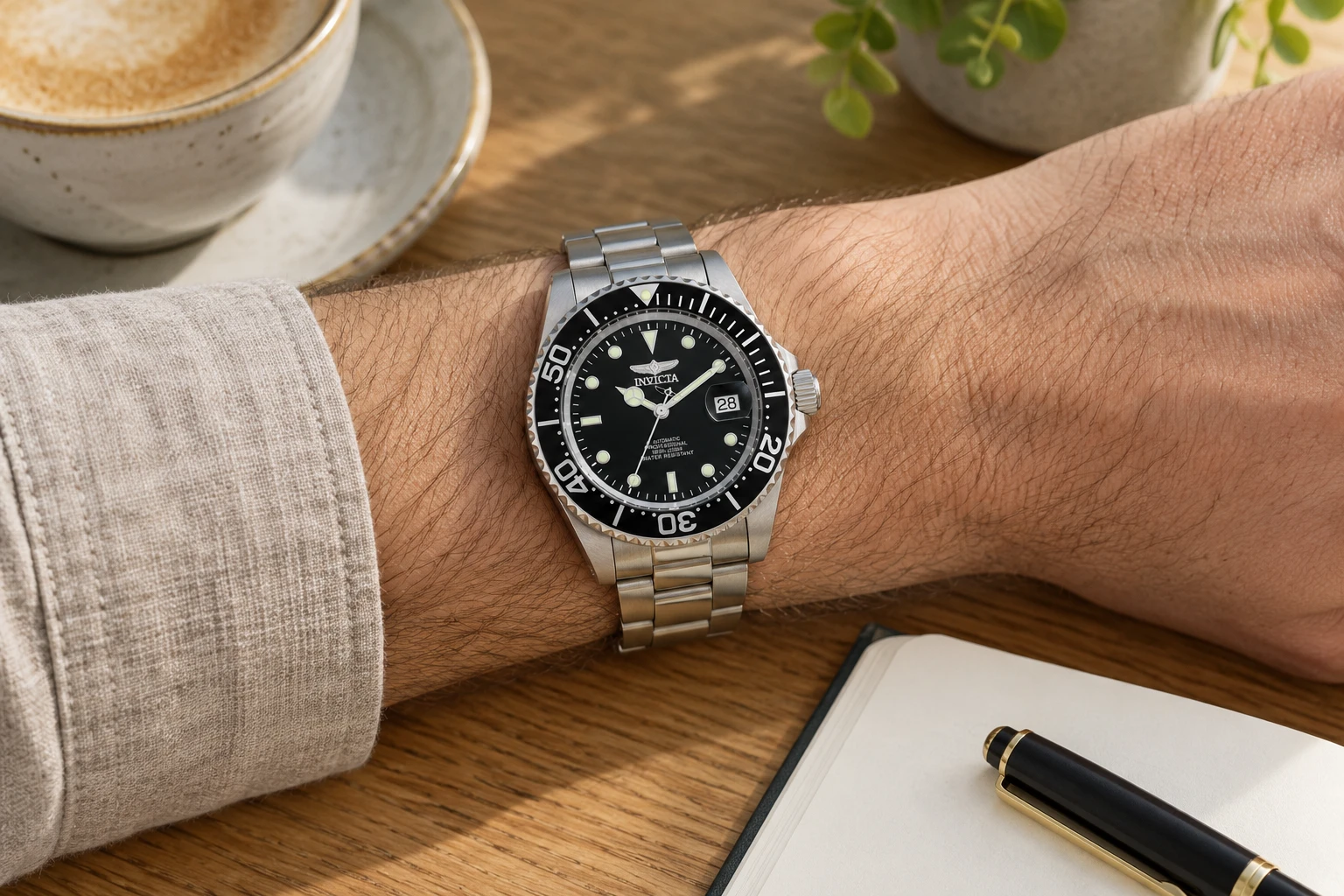
Power reserve is about your rotation, not a one-hour victory
These movements belong to a similar everyday reserve class: Time Module's NH-series information describes more than forty-one hours under its stated conditions, while Miyota lists approximately forty-two hours for the 8215. Those figures should not be used to predict the exact stopping time of a partly wound watch on your bedside table. A small nominal difference is unlikely to settle the better purchase. The more important question is whether your normal wearing pattern keeps the watch running when you want it.
If you leave an automatic off for an entire weekend, plan for the possibility of resetting it. If resetting is the part of ownership you dislike, compare a solar or quartz watch rather than expecting either movement to remove that routine. You do not necessarily need a watch winder for occasional rotation. Follow the brand's starting and setting instructions and consider whether the repeated interaction is enjoyable or annoying to you. That preference is a legitimate buying criterion, not a test of being a serious watch enthusiast.
Jewel count is not a quality score
The published NH35 configuration uses twenty-four jewels, while the 8215 uses twenty-one. Jewels serve particular mechanical bearing functions; counting them does not produce a reliable ranking of finished-watch quality. More is not automatically better, and fewer does not automatically mean fragile. Compare the design as a complete movement, then return to the watch's assembly, regulation, warranty and intended use. A lower jewel count should not distract you from a better-fitting case or a clearer service arrangement.
The same caution applies to sweeping claims such as bulletproof, maintenance-free or Swiss-level accuracy. Those phrases rarely define a test, a duration or a remedy. Ask what the seller actually commits to. Is there a written accuracy tolerance? Who handles a fault? Does opening the case elsewhere affect warranty coverage? Concrete answers help you compare two purchases. A movement nickname and an enthusiastic forum reputation cannot answer those questions on behalf of the company taking your payment.
Movement thickness does not determine watch thickness
Time Module gives the NH35 a height of 5.32mm, while Miyota lists the 8215 at 5.67mm. That difference is useful when studying a casing drawing, but it does not mean every NH35 watch is thinner than every 8215 watch. The crystal, hands, dial, movement holder, caseback and water-resistance construction all contribute to the finished case. Read the watch's dimensions and side profile. The movement alone cannot tell you whether the crown will dig into your wrist or the case will catch a shirt cuff.
For wearing comfort, compare the complete watch with something you already own. Include lug-to-lug length, case shape, bracelet end links and clasp adjustment. A larger-looking case can sit comfortably if its shape suits your wrist, while a smaller diameter can still overhang because of its lugs. If possible, try the watch or use the return window carefully. A movement-focused comparison should help you choose a better watch, not lead you to ignore the part that touches your skin all day.
Neither movement is a casual drop-in replacement for the other
NH35 and 8215 differ in dimensions and casing requirements. Do not order one as a replacement for the other because both have three hands and a date. Movement holders, stem position, dial feet, date-window placement, hand fitting and clearance need to match the actual parts. Even within a movement family, configuration details can matter. A case described as compatible with several movements may need different supplied components; ask for the exact combination rather than assuming a shared label settles it.
If this is a first repair or modding project, obtain the complete parts list and relevant drawings before opening a watch. A qualified repairer can often identify a compatibility problem faster than a box of speculative replacement parts. Water resistance also needs appropriate verification after case work; installing a movement does not establish the finished case's sealing. Our NH36 versus 4R36 guide explains why movement specifications and complete-watch claims should stay separate even when the calibers are closely related.
Sound and seconds-hand behavior need a careful diagnosis
Owners sometimes describe rotor noise or an uneven-looking seconds hand when discussing inexpensive automatics. Those observations deserve a specific description, but they do not establish a universal defect rate for a caliber. The case can affect what you hear, and a visible hand movement is not the same measurement as the watch's accumulated time error. We have not measured noise or seconds-hand behavior across a representative sample, so we do not assign either movement a score for those characteristics.
If a delivered watch stops unexpectedly, loses time abruptly or makes a new abnormal sound, document the symptoms and contact the seller or brand. Do not repeatedly shake it to force it back into motion, and do not open a warranted watch to investigate an online theory. Include when the problem happens, how the watch was started and whether it was being worn. The aim is to separate a normal characteristic, an adjustment issue and a fault using evidence that applies to the actual unit.
Service cost depends on where you live and what you bought
It is tempting to declare one movement cheaper to replace and end the comparison there. In practice, parts, labor, shipping, warranty coverage and local repair options all contribute to the bill. A movement swap can also require casing work and checks on the completed watch. Get a real quote if service cost is central to the purchase. The amount someone paid in another country for a different case is not a reliable estimate for your own watch.
Also ask whether the brand can supply model-specific parts such as a crown, crystal, dial or bracelet component. A common movement does not guarantee that every other part of the watch is easy to obtain. If you plan to keep it for years, the service route deserves as much attention as the initial discount. This is particularly useful when comparing a recognizable manufacturer with an unfamiliar seller whose product description focuses almost entirely on the movement name.
Read the seller's listing as a set of promises
Confirm the full watch reference, movement version, hacking behavior if important, stated accuracy policy, crystal, case dimensions and return process. Look for clear photographs of the actual version rather than a mixture of renders and unrelated variants. If the listing uses NH35, 8215 and other caliber names as selectable options, save the exact choice before paying. An Amazon search result can include several different models or parts rather than a complete watch, so inspect the individual product page.
Treat owner reviews as prompts for questions, not as a dataset you have personally analyzed. A useful comment about a stiff crown or poor bracelet fit should send you to check that feature on the same reference. It should not become a percentage of satisfied owners without a reproducible method. We have not computed an Amazon review score for either caliber. The most valuable buying evidence combines a clear listing, relevant owner observations, manufacturer documentation and a seller who answers specific questions.
Which one should you choose?
Choose an NH35-powered watch when the complete product suits your wrist and use, its stated features are clear and the service route makes sense. Apply exactly the same standard to an 8215-powered watch. Verify hacking on the actual 8215 version rather than relying on an old comparison chart. If two watches are otherwise close, compare their regulation promise, bracelet, seller and return terms before using the movement as a tie-breaker. Those details are more likely to shape your ownership than a broad internet verdict.
If your priority is highly consistent time with very little resetting, reconsider whether an automatic is the right category at all. A solar or quartz watch may fit that need better without making either mechanical movement a bad product. For a mechanical purchase, buy the watch whose compromises you understand and accept. Keep the applicable manual and order details, establish a simple timing baseline after arrival and use the stated support process if the unit does not meet the promises made for it.
Make the next step concrete.
Your before-you-buy checklist
Use this as a personal decision list. The boxes stay in this page session; your answers are not submitted.
Mark the checks that you have completed.
Clear answers, without the shortcuts.
Questions readers ask
Does the Miyota 8215 hack?
Miyota’s current 8215 product page lists a stop-second device. Older descriptions and older stock may differ, so confirm the specific watch or batch offered by the seller.
Is NH35 automatically more accurate than 8215?
No. Compare the relevant specification and test conditions with the finished watch’s regulation promise. A caliber name or one brief instrument reading cannot establish a universal accuracy winner.
Can I replace an NH35 with an 8215?
Do not assume a drop-in replacement. Dimensions, holders, stems, hands, dial feet and date positioning must match the exact parts and casing drawings.
How should I compare everyday timekeeping?
Keep a consistent signed timing log over complete days without resetting during the interval. Divide the change by elapsed days, and record wearing or storage changes. That is an ownership observation, not a controlled laboratory trial.
When the checks are settled.
Compare the exact offer
The links below open model-specific Amazon searches and may include other versions, accessories or unrelated results. Check the selected reference, seller, condition, delivered total, warranty and return terms before ordering.
As an Amazon Associate, we earn from qualifying purchases. We do not publish unverified live prices, availability, sales counts or star ratings. How our links work.
Explore the everyday picks →Evidence and limits.
Sources and how this review was prepared
This article was prepared by NextGen Editorial Desk from the published manufacturer specifications and manuals, checked October 15, 2026. It is a researched assessment. We have not claimed hands-on ownership, laboratory measurements, pressure tests, scratch tests or a representative analysis of Amazon reviews. Suggested arrival checks and arithmetic examples are guidance, not results from a tested sample.
Lifestyle scenes illustrate everyday settings and styling. They do not establish exact dimensions, fit, color accuracy or performance. Use the manufacturer's original product information to verify fine details. Manufacturer claims, our interpretation and your own checks are kept distinct.
- Time Module: NH35 product lineup and technical links
- Time Module: NH35 specification and drawings
- Miyota: current 8215 specification and stop-second listing
- Miyota: 8215 instruction manual
If a specification or model revision has changed, use the site contact information and include the exact reference and source. An update should improve the evidence, not merely change the date.
Keep following the useful question.
Read next
The next good question
Keep exploring.
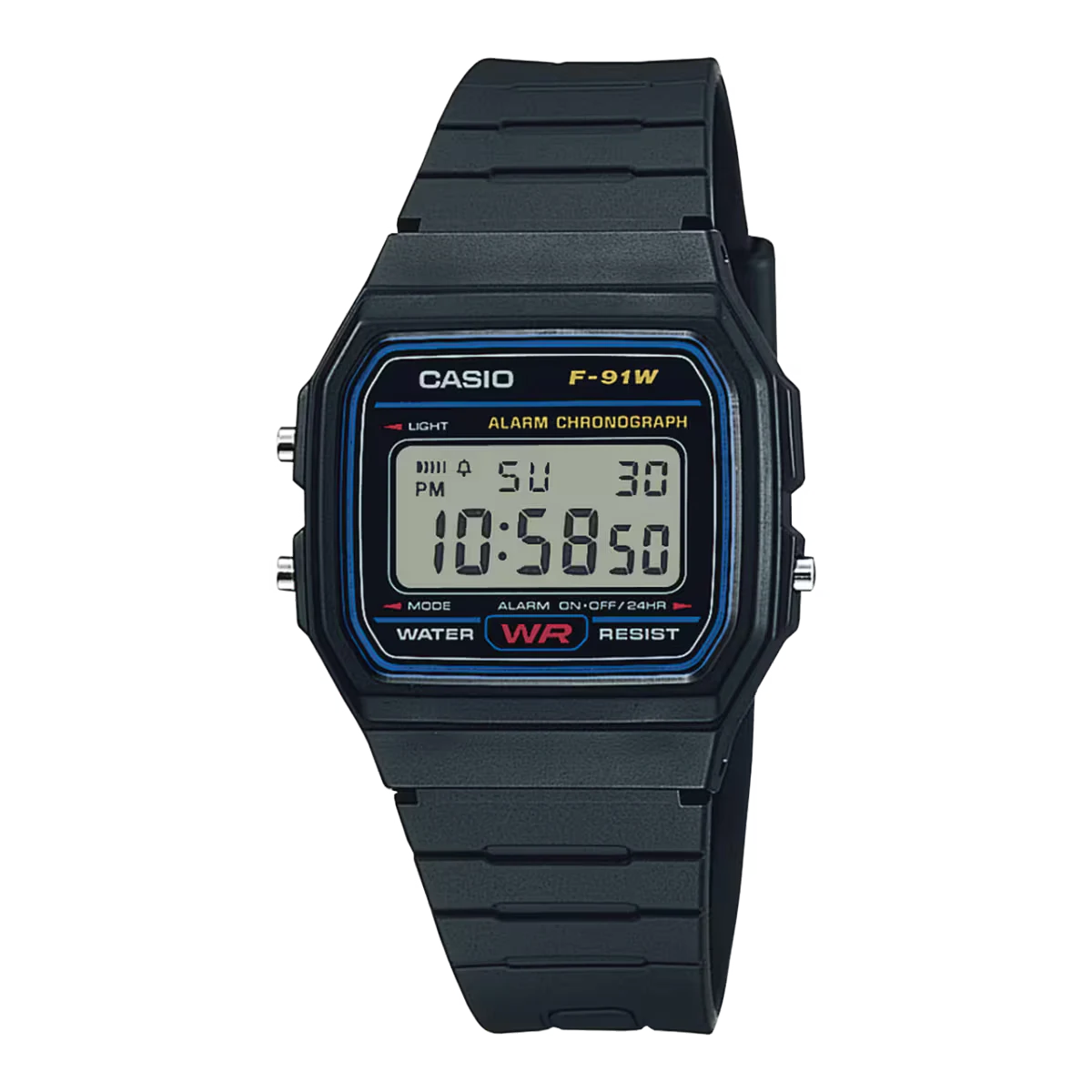 Read the story ↗
Casio F-91W vs A158WA vs AE-1200 vs A168: Which One Fits?
Compare four classic Casio digital watches by size, display, everyday features and use case, with official specifications and clear trade-offs.
 Read the story ↗
NH35 vs Miyota 9015: What Changes in Daily Use?
Compare the movement, then judge the watch built around it.
 Read the story ↗
100m vs 200m Water Resistance: What Watch Ratings Actually Tell You
A 100m or 200m marking is a laboratory-rated pressure specification, not permission to dive to that depth in ordinary conditions. Use the exact manufacturer instructions, check crown and gasket condition, and distinguish everyday water resistance from a certified diver’s watch. The extra rating is useful margin, but it does not replace maintenance or correct use.