Automatic vs Solar Watch for Everyday Wear: Which Movement Fits Your Life?
A practical movement guide for choosing the charm of an automatic watch or the low-maintenance reliability of a light-powered watch.
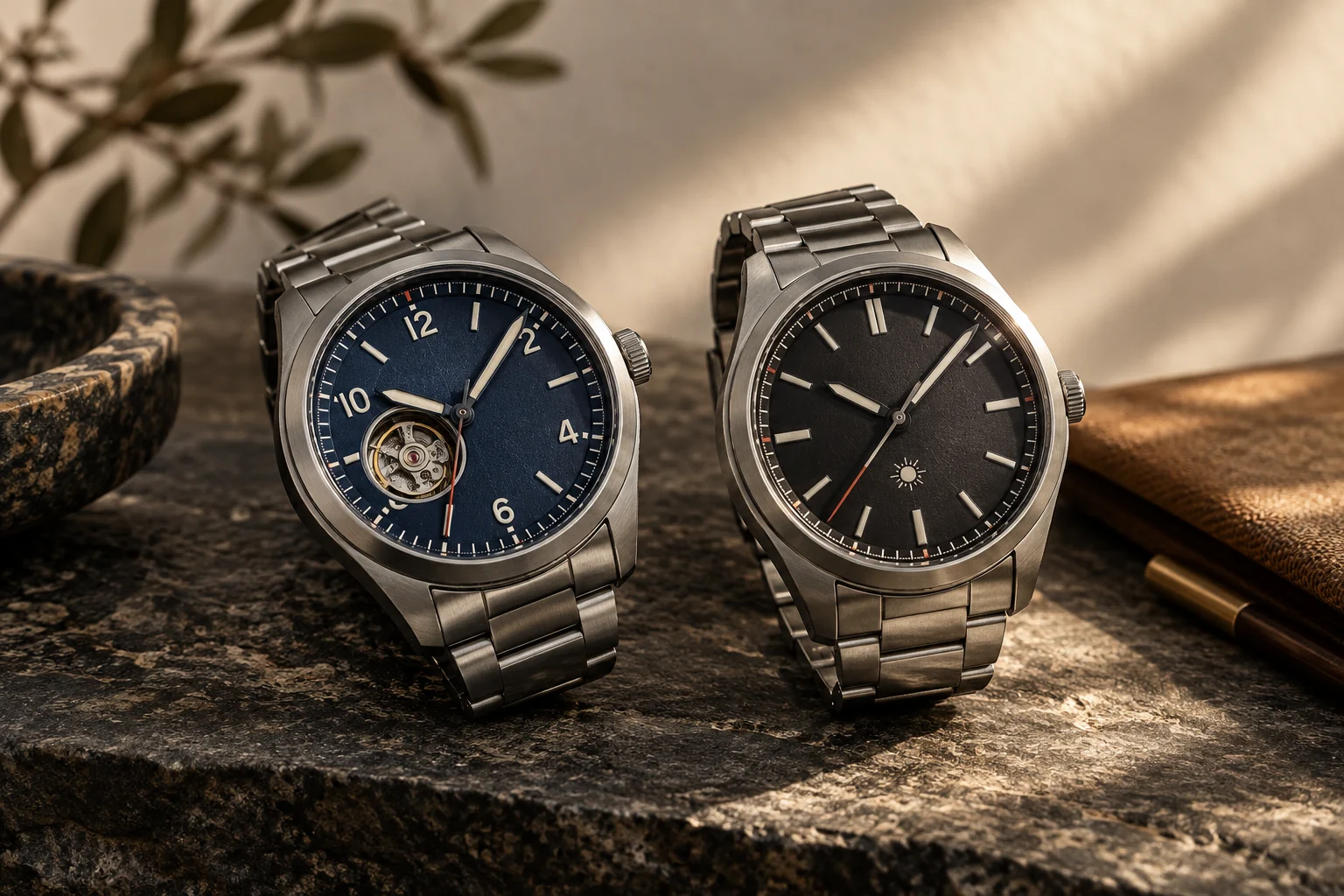
Choose a solar watch when accurate, low-maintenance timekeeping is the priority: regular exposure to light keeps it charged, and there is no routine battery swap on systems such as Citizen Eco-Drive. Choose an automatic watch when the mechanical movement, sweeping seconds hand, and ritual of wearing and setting the watch are part of the appeal. A solar watch is the easier one-watch tool; an automatic is the more involving object. Case fit, legibility, water resistance, and service support still matter more than movement romance.
| Ownership question | Automatic watch | Solar watch |
|---|---|---|
| Power source | Wrist motion and/or hand winding | Light stored in a rechargeable cell |
| Timekeeping | Varies by movement and wear | Quartz-regulated and typically more precise |
| After storage | May stop after its power reserve runs down | Can run for months when fully charged, model dependent |
| Routine attention | Set, wear, and eventually service | Give it light and follow cell/service guidance |
| Emotional appeal | Visible mechanical interaction | Quiet technical dependability |
The choice is really between two ownership experiences
Automatic and solar watches can look almost identical from across a room. Both can come in field, dive, dress, chronograph, and everyday designs. The difference appears in how they live with you. An automatic movement stores energy in a mainspring, wound by a rotor as the watch moves and often by turning the crown. A solar watch uses a photovoltaic system beneath or around the dial to convert light into energy stored in a rechargeable cell. One makes mechanics visible in the routine; the other works to remove the routine.
Neither approach is inherently more “real.” Both represent serious engineering, and both can serve for years when used as designed. The practical decision begins with tolerance for attention. If you want to pick up one watch, find it running, and trust its time, solar is compelling. If setting the hands, feeling the rotor, and accepting a small daily rate variation adds pleasure, automatic ownership offers something a purely convenience-led choice cannot.
How an automatic behaves from day to day
A mechanical automatic watch is powered by a spring and regulated by an oscillating balance. It does not use a conventional battery, but it is not maintenance-free. The watch may stop after sitting beyond its power reserve, so a rotation of several watches means occasional setting. Accuracy is expressed as a daily rate and can change with temperature, position, activity, magnetism, and how fully the mainspring is wound. Seiko’s 4R35 and 4R36 instructions explicitly note that actual daily rate depends on conditions of use.
That variability is part of the category. A watch that gains ten seconds today and loses a few in another resting position is behaving differently from a quartz-regulated solar watch, not necessarily failing. Owners who need exact appointment time can compare against a phone periodically. Owners who value the mechanism may enjoy learning how crown position, overnight placement, and wearing pattern affect the rate. Eventually, cleaning, lubrication, regulation, or repair may be appropriate, with interval and cost depending on movement and use.
How a solar watch behaves
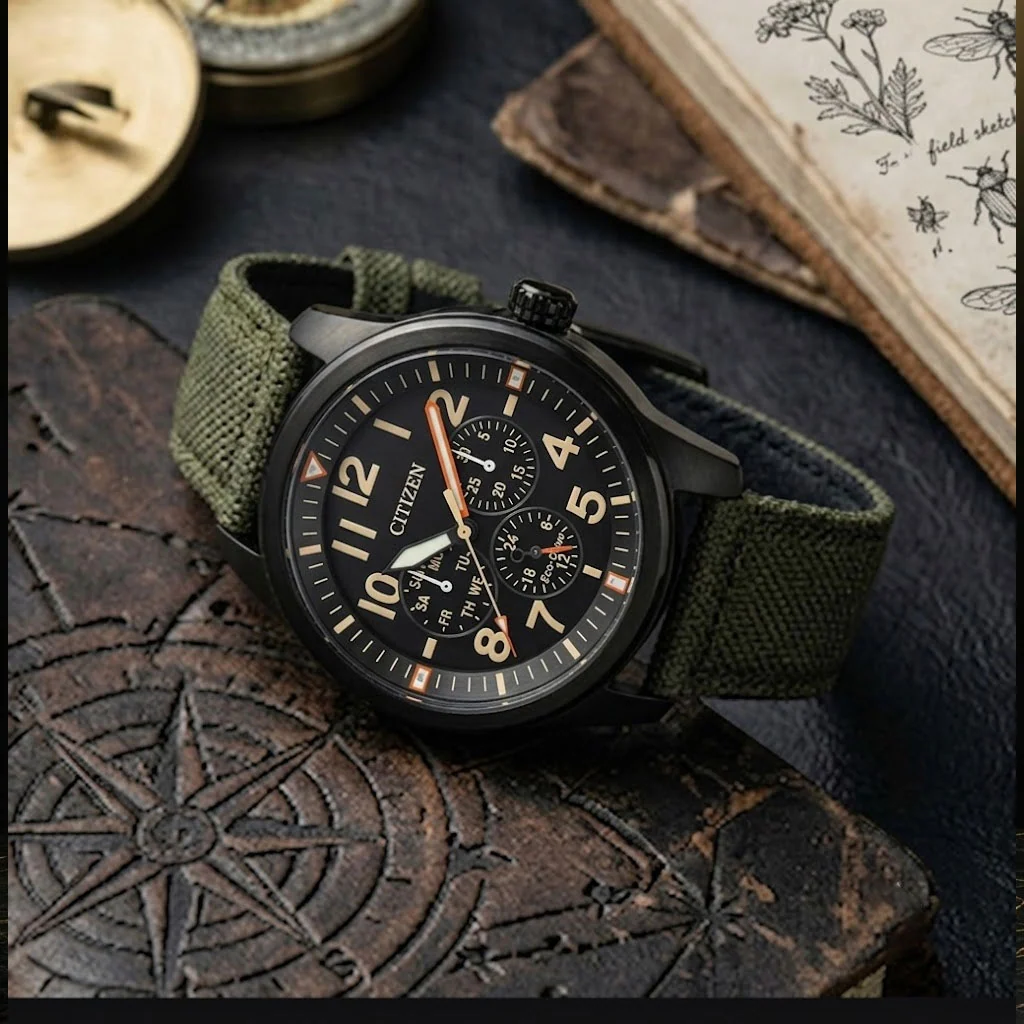
A solar watch is fundamentally a quartz watch with a light-charging system and rechargeable energy storage. Citizen says Eco-Drive converts light ranging from sunshine to indoor illumination and that many models can run for more than six months on a full charge, though model-specific specifications vary. That long reserve makes the watch forgiving. It can move between wrist, desk, and drawer without the weekly reset that a short-power-reserve automatic may require.
Solar does need light. A watch stored for long periods in a closed drawer can discharge, and direct high heat should not be confused with useful charging. Follow the manufacturer’s charging table and expose the dial as recommended. The rechargeable cell is designed for a long service life, but it is still a component rather than a promise of infinite operation. The convenience is real: no routine disposable-battery change and quartz-level timekeeping in a familiar analog form.
Accuracy, travel, and the one-watch use case
Solar is the straightforward winner when the watch is a tool first. Quartz regulation generally keeps far closer time than an entry-level mechanical movement, and a long reserve helps after periods off the wrist. For travel, the watch is likely to be running when packed, and a simple three-hand model can be reset to local time quickly. Radio-controlled or GPS-synchronized solar models add another layer, but a basic solar movement already solves the everyday problem well.
An automatic watch asks for more participation but can still be a dependable daily companion. Wearing it most days keeps the mainspring charged, and many owners are comfortable with small rate variation. A hacking seconds feature makes synchronization easier, while hand winding helps restart the watch. For a one-watch collection, consider whether a stopped watch on Monday morning will feel charming or irritating. That honest reaction is more useful than any abstract hierarchy of movements.
Maintenance and total ownership cost
Mechanical service can cost a meaningful share of an affordable automatic watch, particularly when brand-specific parts or pressure testing are needed. Some owners service only when performance changes; others follow manufacturer recommendations. A common movement may be economical to repair or replace, while a specialized caliber can require a brand service center. Water resistance should be checked after the case is opened, regardless of movement type.
Solar watches reduce routine attention, but seals, crowns, crystals, bracelets, and gaskets still age. A dive-style solar watch is not exempt from water-resistance checks. After many years, the rechargeable cell or electronics may require service. Before buying either type, look for local or mail-in support, published movement information, and a realistic path to parts. A durable case and a serviceable design are more valuable than a movement label alone.
Choose the watch, then choose the movement
Movement should not rescue a poor watch. Check diameter, lug-to-lug length, thickness, dial contrast, lume, crown comfort, bracelet adjustment, crystal, and water-resistance rating. A perfectly accurate solar watch that overhangs the wrist will not become a favorite. A charming automatic with weak legibility may stay in the drawer. Begin with the watch that physically fits the life it must enter, then use movement type to decide between similarly suitable options.
For a first and only everyday watch, solar is the low-friction recommendation. For a first mechanical watch, a widely supported automatic caliber can be an engaging entry into the category. Many collections eventually include both because they answer different moods: the solar watch for travel and reliability, the automatic for tactile interest. The best choice is the one whose small demands still feel reasonable after the novelty of purchase fades.
The decision in one minute
- Choose solar: for accurate grab-and-go use, travel, long reserve, and minimal routine attention.
- Choose automatic: for mechanical interest, winding and setting rituals, and a more interactive ownership experience.
- Check the whole watch: because fit, legibility, water resistance, and service access matter more than the movement label.
- Own both eventually: if you want one dependable tool and one object whose mechanics are part of the pleasure.
Frequently asked questions
Does an automatic watch need a battery?
No conventional battery powers the movement. A mainspring stores energy from the automatic rotor and, on many models, hand winding. The movement still needs eventual maintenance.
Can a solar watch run forever?
No watch should be described that way. Light keeps the rechargeable system operating, but cells, electronics, seals, and mechanical components can age and may eventually require service.
Which is more accurate, automatic or solar?
Solar watches are quartz-regulated and are generally much more accurate than ordinary mechanical automatics. Exact performance depends on the specific caliber and operating conditions.
Can I keep a solar watch in a drawer?
Short storage may be fine when the watch has a healthy charge, but prolonged darkness can deplete it. Follow the model’s charging guidance and give the dial regular light exposure.
How this guide was built
This is a research-based editorial guide, not a claim of laboratory testing or long-term ownership of every product mentioned. We compared manufacturer documentation, standards and workplace guidance where relevant, then translated those details into practical buying questions. We avoid inventing test results, and we link the primary references below so readers can verify specifications and model-specific limits.