Watches / A closer look
NH36 vs 4R36: Accuracy, Specifications and Buying Checks
The numbers only help when you keep their conditions attached. Understand the movement names, read accuracy claims, and choose between a finished watch and a project.
Start here
NH36 and 4R36 share useful functions, but their published accuracy figures use different testing conditions. Compare the technical documents and the complete watch, not just the movement name. An NH36 custom build is not automatically a factory Seiko.
As an Amazon Associate, we earn from qualifying purchases. How our links work ↗
The useful answer
NH36 and 4R36 share useful functions, but their published accuracy figures use different testing conditions. Compare the technical documents and the complete watch, not just the movement name. An NH36 custom build is not automatically a factory Seiko.
As an Amazon Associate, we earn from qualifying purchases. How our links work. Choose the exact model and seller before ordering.
NH36 versus 4R36: begin with the name on the paperwork
You have found two similar mechanical watches. One product listing specifies an NH36 movement; the other specifies a 4R36. Both feature a sweeping seconds hand, hand-winding, hacking (stop-seconds), and a practical day-date calendar window. Both are routinely described as Seiko movements. Is one automatically superior? The useful answer begins with identifying which entity publishes the technical documentation and which company assumes responsibility for the finished timepiece.
Time Module Inc. (TMI) publishes technical specifications for the NH36, which is sold to independent watch assemblers and modification hobbyists. Seiko Watch Corporation publishes consumer instructions for the 4R36 integrated into proprietary factory watches. While sharing nearly identical architecture, these designations distinguish commercial distribution channels from assembly origin. A familiar calibre name does not validate the quality of an aftermarket case, dial, bracelet, or waterproof assembly.
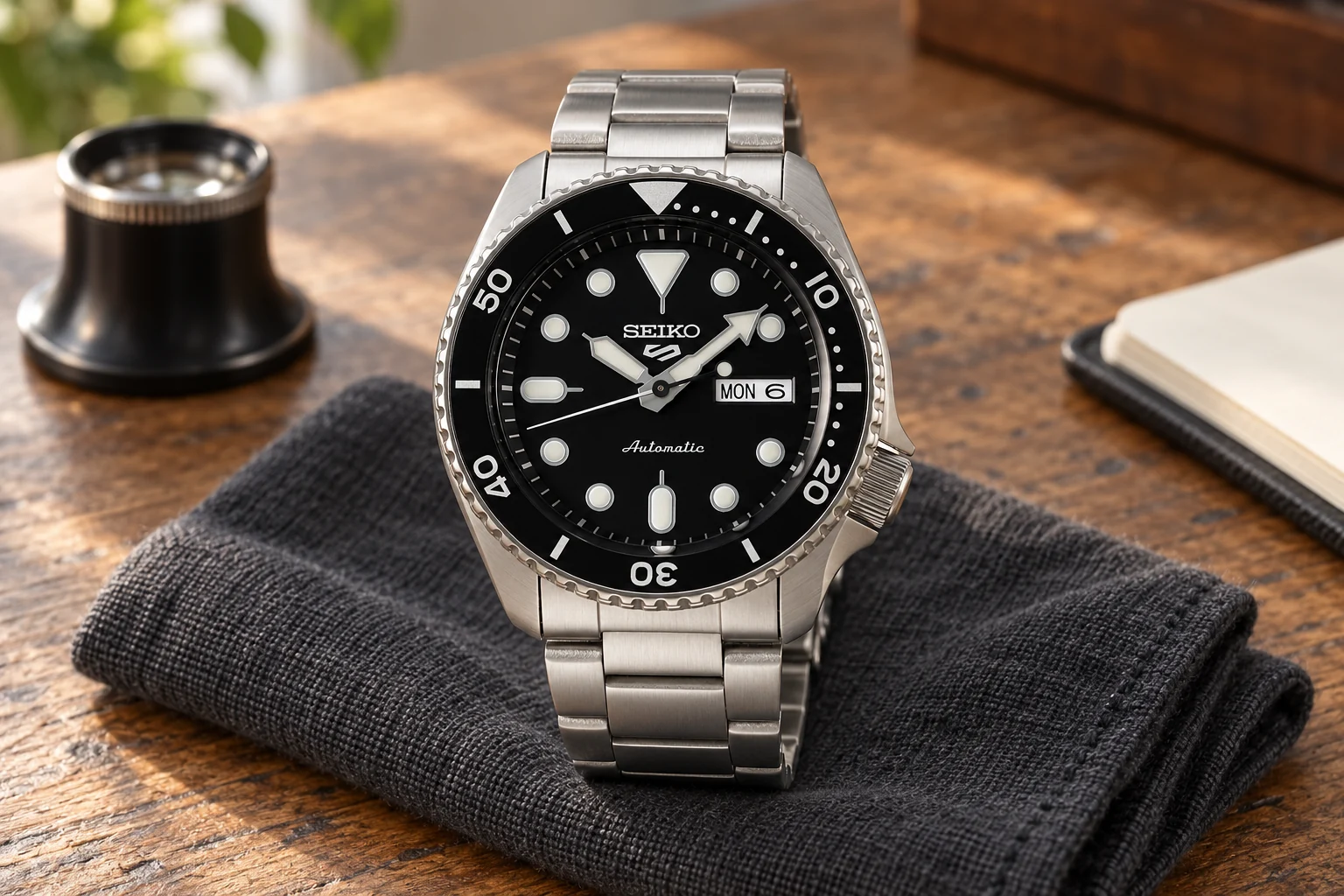
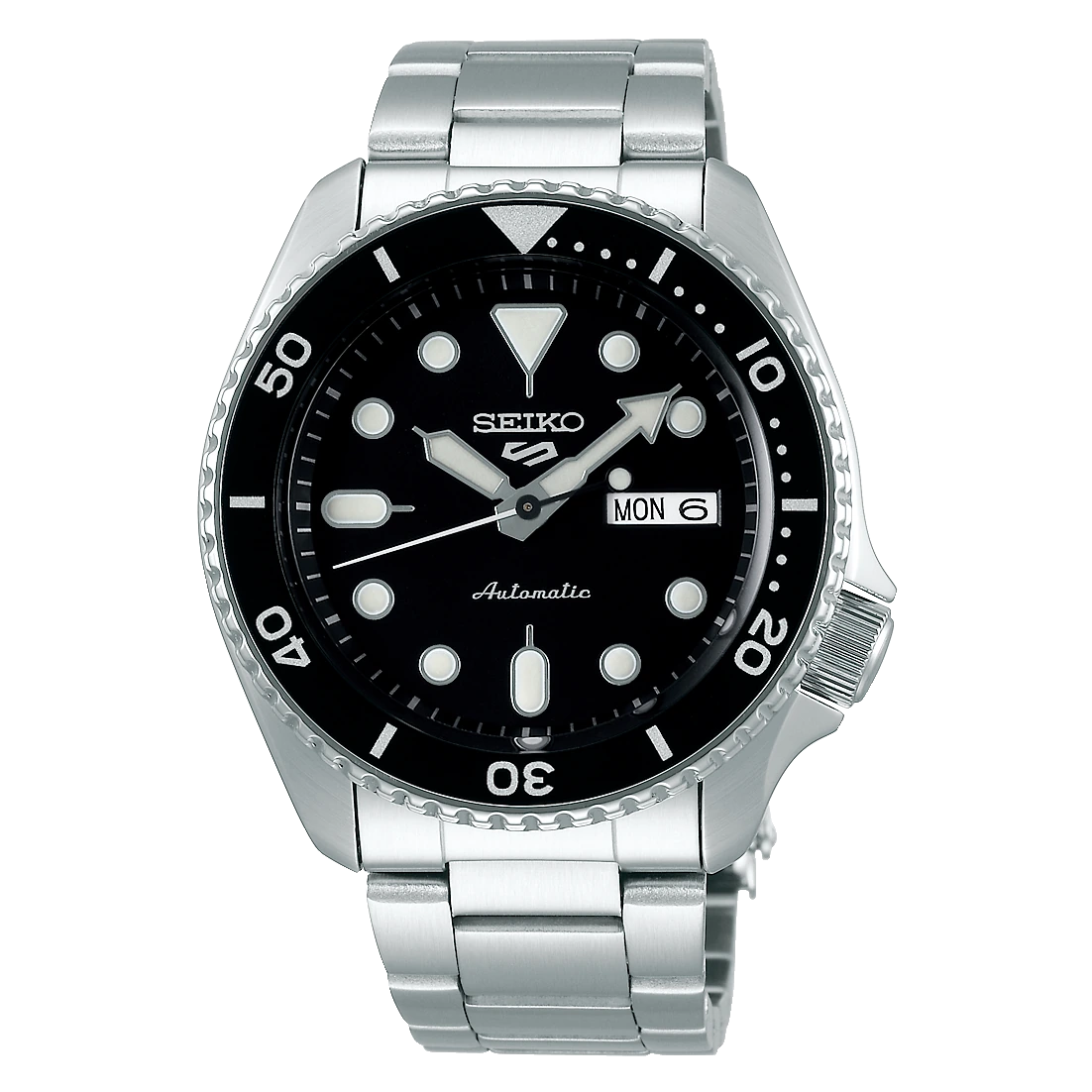
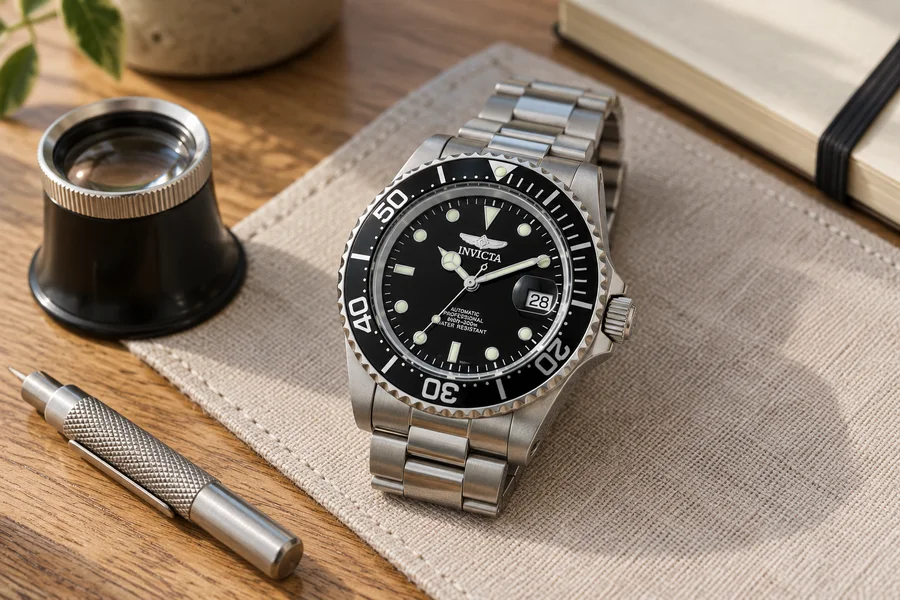
The official product photograph below features a genuine Seiko SRPD55 powered by the factory 4R36 movement. This composite layout presents an official brand image against a neutral workspace backdrop to serve as a finished-watch baseline. Technical diagrams referenced subsequently illustrate functional concepts rather than dissected mechanisms.
When shopping, record five vital data points: the complete watch reference, stated calibre, assembler or brand identity, seller credentials, and warranty support terms. Confirming these variables prevents costly misunderstandings regarding service obligations and authenticity.
Source check: Seiko: SRPD55 finished-watch specifications
The functions you can reasonably compare
Core performance parameters remain identical across both movements: automatic bidirectional winding, manual crown winding, seconds-hacking, and day-date calendars. Both operate at 21,600 vibrations per hour (3 Hz) and incorporate 24 synthetic ruby jewels. These metrics describe mechanical design, not the final regulation quality or assembly cleanliness of a specific retail specimen.
A frequency of 21,600 vph produces six discrete ticks per second, creating a smooth visual sweep on the seconds hand without demanding the heightened maintenance intervals of high-beat alternatives. However, frequency alone does not dictate real-world timekeeping precision.
Stop-seconds (hacking) simplifies time setting against reference clocks, while manual winding restores power reserves without requiring vigorous wrist motion. Neither feature eliminates the need for proper crown operation habits or adherence to calendar quickset safety windows. On diver-style or sports watches, screw-down crowns require careful engagement to protect internal moisture seals.
Published power reserve ratings are comparable: Seiko specifies approximately 41 hours, while TMI technical guidelines indicate a minimum of 41 hours following full mainspring tension under standardized laboratory testing.
Source check: TMI: NH36 technical guide, Version 03 · Seiko: 4R36 consumer specifications
| Feature | NH36 Technical Documentation | 4R36 Consumer Documentation |
|---|---|---|
| Core Functions | Automatic & manual winding, hacking, day-date | Automatic & manual winding, hacking, day-date |
| Operating Frequency | 21,600 vibrations per hour (3 Hz) | 21,600 vibrations per hour (3 Hz) |
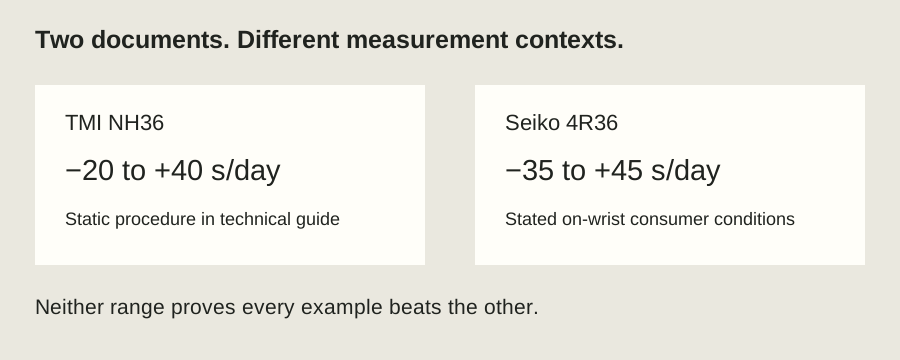
| Stated Rate Tolerance | -20 to +40 seconds per day (Static test parameters) | -35 to +45 seconds per day (On-wrist environmental conditions) |
| Evaluation Method | Factory laboratory positioning | Simulated everyday wear range |
Why the accuracy ranges look different
Seiko consumer manuals specify a factory adjustment window of -35 to +45 seconds per day under simulated on-wrist conditions spanning 5°C to 35°C. Conversely, TMI's NH36 technical specification cites a static rate range of -20 to +40 seconds per day evaluated across specific testing positions following full winding.
Directly contrasting these figures to declare one movement inherently more accurate is technically invalid because the underlying testing methodologies and environmental constraints differ. Validating performance disparities requires side-by-side laboratory testing of identical sample sizes under identical protocols.
View published specifications as diagnostic inquiries rather than absolute guarantees. Inquire about the exact testing standard applied by a custom assembler or brand before assuming a specific daily rate.
Source check: TMI: NH36 technical guide · Seiko: 4R36 conditions
A timegrapher reading needs its conditions attached
TMI documentation outlines strict protocols for evaluating the NH36, including power reserve states, stabilization intervals, and specific positional orientations (such as dial-up or crown-down). TMI guides mandate a 53-degree lift angle for optimal diagnostic calibration.
When viewing seller-supplied timegrapher screenshots, confirm whether the testing parameters match official factory guidelines. An isolated numeric rate without positional context or lift angle disclosure offers limited diagnostic value.
Avoid treating timegrapher metrics (rate deviation, amplitude, and beat error) as uniform scores. They measure distinct mechanical behaviors under specific stress tests. Professional horological evaluation interprets these variables cohesively.
Source check: TMI: NH36 technical guide, Version 03
Make an owner log before deciding that something is wrong
To assess your mechanical watch objectively, establish a disciplined seven-day monitoring routine against a verified atomic reference clock. Record timing offsets at the exact same hour daily without constant intermediate resetting.
Calculate daily rate variations by noting net deviation across 24-hour intervals. Track wearing patterns, resting positions overnight, and activity levels. Systematic record-keeping provides actionable data for a professional watchmaker should service become necessary.
Source check: Seiko: mechanical accuracy guide
NH36 does not make every mod a factory Seiko
Aftermarket custom watches built around NH36 calbires offer appealing design customization, but they remain third-party modifications. Verify the source and quality of internal components, case finishing, and waterproofing assemblies before purchase.
Water resistance is a function of total case engineering, gasket integrity, and professional pressure testing—not an inherent property of the movement. Ensure your builder provides transparent documentation regarding assembly standards and after-sales support.
Compatibility: use a parts checklist, not a nickname
While components labeled "NH36 compatible" offer broad interchangeability, successful modification projects demand rigorous verification of dial feet placement, hand hole sizing, calendar disc alignment, and stem stem stem geometry.
Your decision checklist
Review and verify each requirement before committing to a purchase or modification project.
What to ask before buying a replacement movement
Diagnose power and operational faults fully before sourcing replacement calibres. Should a movement swap be warranted, confirm exact day-date wheel orientations, stem types, and supplier warranty terms to ensure seamless integration.
Compare complete offers, not just calibres
Evaluate watches holistically by examining finishing, bracelet quality, crystal materials, and merchant support terms rather than focusing exclusively on the movement designation.
When regulation is—and is not—the next step
Rely on verified multi-day owner logs before requesting professional regulation. Minor rate offsets within normal mechanical operating tolerances often require no intervention.
Reading a seller's accuracy claim without losing the context
A promotional claim stating an NH36 movement is "regulated" warrants clarification regarding testing positions and amplitude. Combine empirical personal observations with verified documentation for balanced decision-making.
Choose between a complete watch and a project
Decide whether you seek a dependable finished timepiece ready for daily wear or an engaging modification project requiring specialized tooling and technical patience.
Before you decide.
Does an NH36 guarantee a more accurate watch than a 4R36?
No. Published accuracy ranges, testing conditions, regulation quality, and the overall finished watch assembly need to be evaluated together rather than relying solely on the movement name.
Should I replace a running automatic movement after one timegrapher reading?
First establish the environmental settings, test positions, power state, and actual daily wearing behavior. A single isolated timegrapher reading does not diagnose a broken movement.
The next good question
Keep exploring.
 Read the story ↗
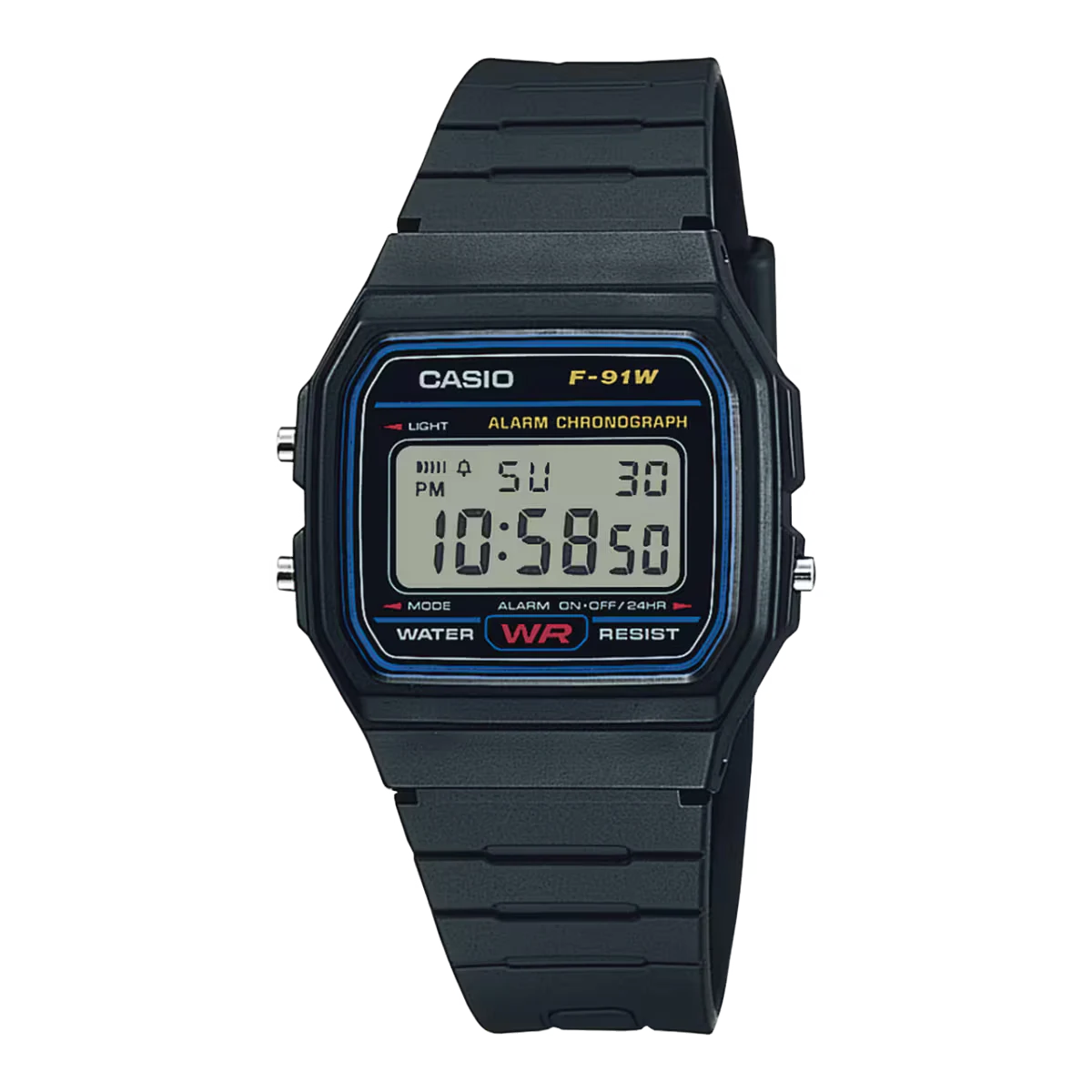
Casio F-91W vs A158WA vs AE-1200 vs A168: Which One Fits?
Compare four classic Casio digital watches by size, display, everyday features and use case, with official specifications and clear trade-offs.
 Read the story ↗
NH35 vs Miyota 8215: Accuracy, Hacking and the Watch You Buy
Start with the version. Finish with the complete watch.
 Read the story ↗
Sapphire vs Mineral vs Acrylic Watch Crystal: The Real Tradeoffs
Scratch resistance is only one part of a watch crystal. Here is how sapphire, mineral glass, and acrylic differ in daily use and repair.