Over-Ear Headphones vs Earbuds for Remote Work: A Day-Long Comfort Guide
A workday-focused comparison of over-ear headphones and earbuds for calls, focus, portability, and long sessions.
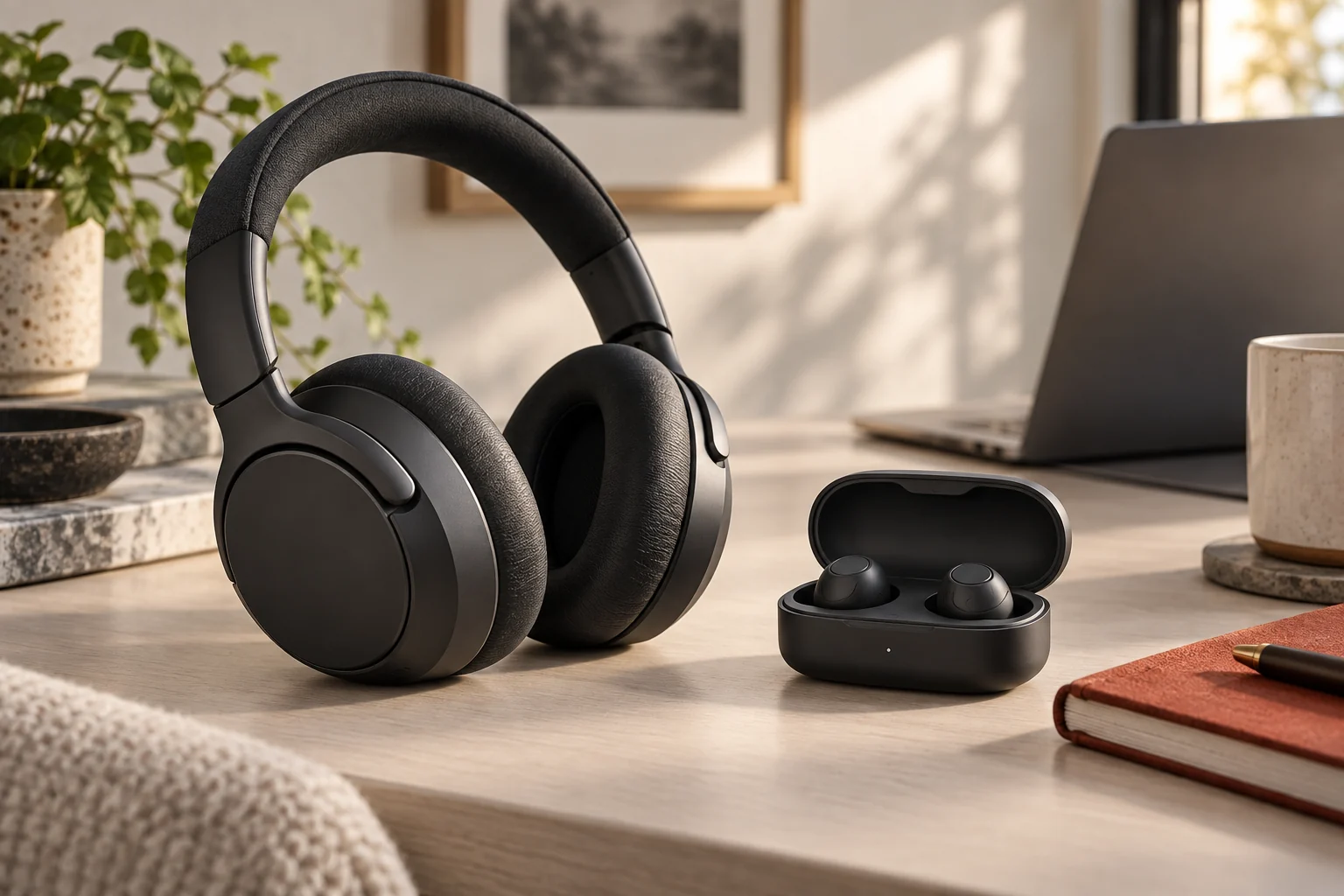
Over-ear headphones are usually the better primary tool for long focus sessions because they spread contact around the ear, offer larger controls, and often provide longer battery life. Earbuds are better for portability, short calls, switching locations, and avoiding headband pressure. Microphone quality depends more on the specific model and room than on the category. For a full remote-work week, the most flexible setup is often one comfortable over-ear pair at the desk and simple earbuds as a backup.
| Work need | Over-ear headphones | Earbuds |
|---|---|---|
| Long focus blocks | Often more stable for hours | Fit varies; ear-canal pressure can build |
| Calls on the move | Bulky | Compact and discreet |
| Battery | Commonly longer per charge | Shorter per charge plus case recharges |
| Isolation | Strong passive seal plus optional ANC | Seal dependent; ANC varies widely |
| Portability | Needs bag space or a case | Pocket friendly |
Choose around the calendar, not the product category
A remote worker with six hours of focused editing has a different audio problem from someone who takes short calls between school runs and coffee shops. Look at a typical week. Count long concentration blocks, video meetings, phone calls, travel, and moments when you need to hear the room. Then identify the failure that matters most: pressure, heat, battery anxiety, poor microphone pickup, unstable fit, or carrying bulk. The correct form follows that pattern.
Audio quality matters, but work equipment must disappear into the routine. A detailed pair of headphones is a bad work tool if the clamp becomes distracting after forty minutes. Tiny earbuds are not convenient if they need constant adjustment. Start with fit and use pattern, then compare noise control, microphones, controls, device switching, and sound. This order avoids paying for premium features on a shape you cannot comfortably wear.
Over-ear headphones: the desk-first choice
Over-ear headphones surround the ear with padded cups and distribute weight across the headband. A good fit can remain stable through long sessions without placing anything in the ear canal. Large batteries and physical controls are easier to package, and active noise cancellation can reduce steady sounds such as fans, HVAC, and low-frequency traffic. Models with an ambient mode let some outside sound back in when awareness matters.
The disadvantages are heat, clamp, hair or glasses interference, and bulk. Soft pads can still become warm. A heavy model can create a pressure point at the crown. Thick glasses temples may break the seal and change both comfort and bass. Measure success after a full meeting block, not a five-minute store trial. Replaceable pads and a moderate weight can matter more over two years than an extra sound preset.
Earbuds: the mobile and flexible option
Earbuds fit into a pocket, pair well with phones, and move easily between a desk, walk, train, and shared office. Their charging case provides several top-ups, so short sessions can continue across the day even when the buds themselves have less runtime than large headphones. They also avoid headband pressure and leave hairstyles untouched. For short calls and a mobile schedule, that convenience is difficult to beat.
Fit is more individual. Ear tips that are too small can leak sound and weaken noise cancellation; tips that are too large can create pressure. Some people dislike any sealed in-ear feeling, while others forget the buds are present. Microphones sit farther from the mouth than a boom mic and may rely heavily on signal processing. Wind and a reflective room can expose those limits. Buy where the return policy allows an honest fit trial and keep the tips clean.
Microphone quality is a room-and-device system
Neither over-ear nor in-ear automatically wins calls. A boom microphone placed close to the mouth often captures speech reliably, but many consumer over-ear models use microphones in the earcups. Earbuds use beamforming and processing to separate voice from the environment. Results change with firmware, laptop Bluetooth behavior, conferencing software, and room acoustics. Hard bare walls can make any microphone sound distant.
Test the actual meeting application because Bluetooth profiles and software noise suppression can change the sound. Record a sample with the air conditioner running and type while speaking. Confirm that mute controls work as expected and that the device does not switch unpredictably between phone and computer. If calls are business-critical, a small dedicated USB microphone or certified headset may deliver a larger improvement than moving between two consumer audio categories.
Battery, switching, and the friction you notice every day
Over-ear models commonly offer enough endurance for several workdays. Sony lists up to 35 hours of music playback with noise cancellation on and up to 50 hours with it off for the WH-CH720N, although real use varies with volume, calls, codecs, and features. Earbuds divide power between the buds and case; the total may be generous, but an individual bud can still run down during a long day. Fast-charge behavior is useful when a meeting begins unexpectedly.
Multipoint Bluetooth can keep a computer and phone connected, but implementation matters. Some devices prioritize an incoming phone notification and interrupt a call. Others require a manual switch. Wired listening is a valuable fallback on over-ear headphones, although the microphone or active features may behave differently over cable. For earbuds, check whether either bud can work alone so one can charge while the other handles audio.
Build a simple two-mode setup
If the budget permits, use over-ear headphones as the desk tool and modest earbuds as the mobile backup. The two shapes distribute pressure differently, and one device can charge while the other works. This does not require two premium purchases. Spend on the device used for the longest blocks, then choose a reliable backup with a stable fit and clear controls. A wired pair kept in the drawer can be an even simpler emergency option.
If choosing only one, select over-ear for mostly seated work, long focus periods, and strong preference for an enveloping sound. Select earbuds for frequent movement, mixed phone and laptop use, hot rooms, or dislike of headbands. In either case, keep volume moderate, use transparency when situational awareness matters, and take short breaks. The best work audio system supports concentration without isolating you from the practical needs of the day.
The decision in one minute
- Choose over-ear: for long desk sessions, longer per-charge battery, large controls, and steady environmental noise.
- Choose earbuds: for movement, travel, short calls, small bags, hot rooms, and freedom from headband pressure.
- Add a call-first headset: when microphone reliability matters more than music quality or compactness.
- Keep a backup: because charging, Bluetooth switching, and meeting software can fail at the worst time.
Frequently asked questions
Are over-ear headphones always more comfortable?
No. Clamp, weight, pad heat, glasses, and head shape can create pressure. They avoid ear-canal contact, but comfort still depends on the specific design and fit.
Are earbuds good enough for professional calls?
Many are, particularly in a quiet room, but performance varies in wind and noise. Test the exact meeting app and consider a dedicated microphone or certified headset for critical calls.
Does active noise cancellation block voices?
ANC is generally strongest against steady low-frequency sounds. Voices are variable and may remain audible, though the physical seal and processing can reduce them.
Should I use multipoint Bluetooth for work?
It is convenient for a phone and computer, but test notification and call behavior. If switching causes interruptions, disconnect the secondary device during important meetings.
How this guide was built
This is a research-based editorial guide, not a claim of laboratory testing or long-term ownership of every product mentioned. We compared manufacturer documentation, standards and workplace guidance where relevant, then translated those details into practical buying questions. We avoid inventing test results, and we link the primary references below so readers can verify specifications and model-specific limits.