Watches / A closer look
One Watch for Work and Weekends: A Practical Buying Guide
A watch should work with the week you have. Here is how to balance office clothes, relaxed weekends and the details that affect everyday comfort.
Start here
The useful answer
As an Amazon Associate, we earn from qualifying purchases. How our links work ↗
The useful answer
For one watch across work and weekends, prioritize a comfortable case, clear dial and a style that matches your real dress code. Check cuff clearance and strap care before adding features. A light-powered analog watch is a practical low-fuss route; a simple digital or automatic can be equally valid when its appearance and ownership routine fit.
Compare the buying routes ↓| Your week | Useful direction | Reason to pass |
|---|---|---|
| Mostly casual office, occasional client meeting | Restrained analog dial and manageable thickness | Your workplace requires more formal accessories |
| Desk work plus active weekends | Comfortable, readable, easy-care option | Bulky case interferes with typing or sleeves |
| Rotating watches or irregular wear | Quartz or properly maintained light-powered option | You dislike checking charge or batteries |
| Mechanical interest is part of the pleasure | An automatic whose fit you have checked | Resetting after time off would annoy you |
The idea of one watch for everything sounds neat until you get dressed on Monday. The watch that looks great with a sweatshirt might catch under a shirt cuff. The polished bracelet you like at dinner might press against a laptop all afternoon. None of those problems makes the watch bad. They mean “versatile” needs a definition that belongs to your week.
This guide is about a practical everyday compromise, not a claim that one accessory suits every workplace or activity. We will work from clothing, comfort and routine toward specific models. Our recommendations come from published specifications and use-case analysis, not a week of personal testing. Product scenes are illustrations; exact dimensions, appearance and instructions remain matters for the manufacturer and the offer you choose.
1. Start with the strictest part of your week
List the situations where you actually wear a watch, then identify the least flexible one. For many readers that is work. A casual studio, customer-facing store and conservative professional office can have different expectations. Look at the written dress code and the people whose role resembles yours. A watch should help you feel prepared, not make you wonder whether it is appropriate all day.
If your workplace requires formal clothing, a restrained watch may be easier to integrate than a bulky sports design. That is a styling judgment, not a rule about price or brand. If your office is relaxed, a digital watch may be entirely natural. If jewelry is restricted for safety or hygiene, no amount of styling advice overrides that requirement. You may need to remove the watch during specific tasks.
Now add the weekend. Are you walking around town, gardening, swimming, going to dinner or spending most of the day at home? A café photograph does not answer those questions. The strongest requirement may be a manufacturer-approved water activity or an easy-to-clean strap rather than a more formal dial. Make that need visible before you choose the case.
Write a sentence such as “This watch needs to work with an untucked Oxford shirt, dark trousers and weekend denim, and it must be comfortable at a keyboard.” That sentence is your buying brief. If a candidate cannot satisfy it, being popular online will not help. If a modest watch does satisfy it, there is no need to keep upgrading the brief to justify something more expensive.
2. Check the cuff, desk and wrist together
Cuff clearance depends on the shirt as well as the watch. Try the exact kind of sleeve you wear most often, with its usual button fastening. A case may technically fit underneath but still snag whenever you reach for a cup. Thick outerwear introduces another interaction. The aim is comfortable movement, not squeezing a watch under the tightest possible cuff for a photograph.
At a desk, pay attention to the underside of the wrist. A bracelet clasp can be more noticeable than the case itself. If you rest your forearm while using a mouse, a large clasp or stiff strap tail may bother you. Try ordinary movements for several minutes. A wrist lifted in front of a mirror tells you less than typing a paragraph or reaching into a bag.
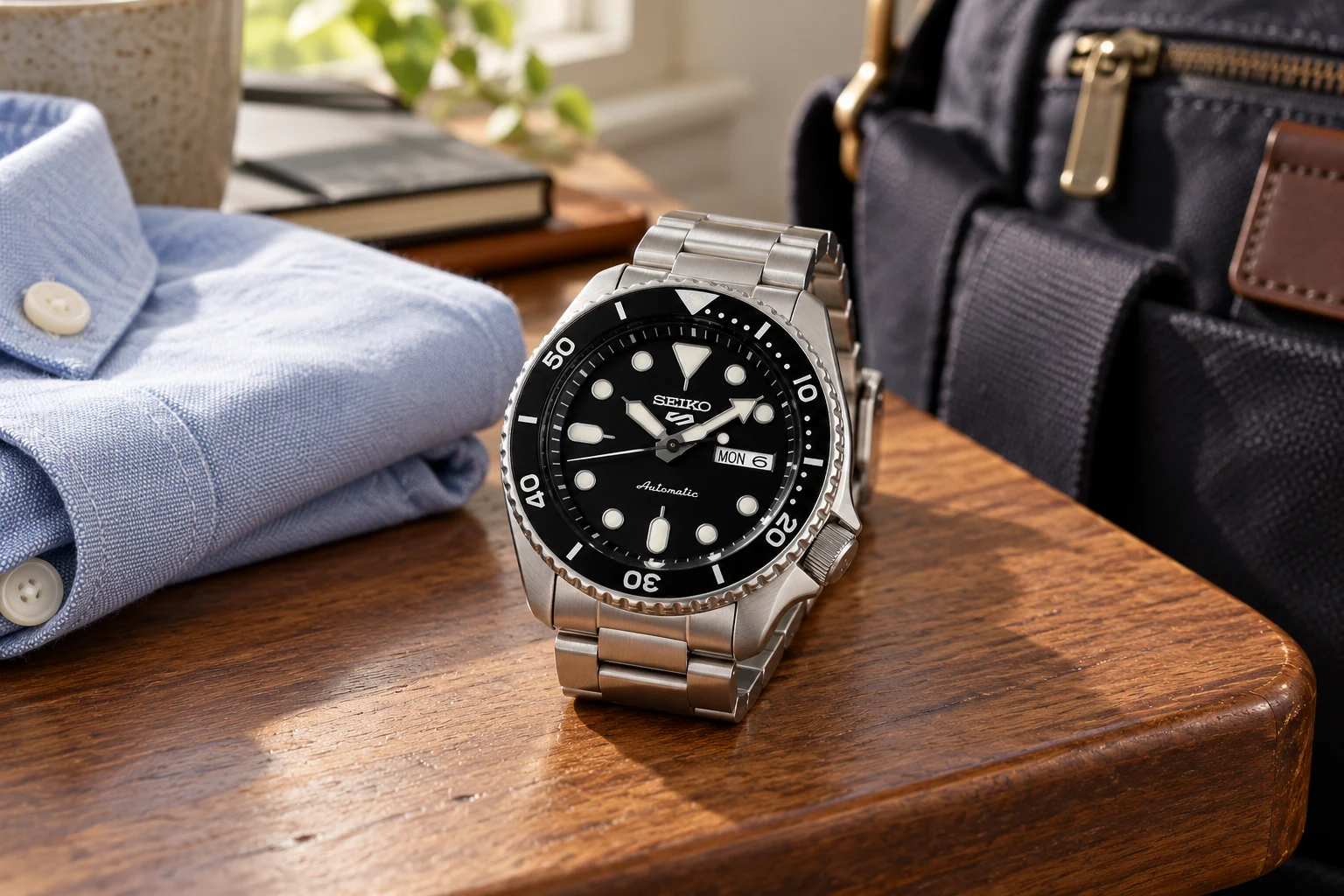
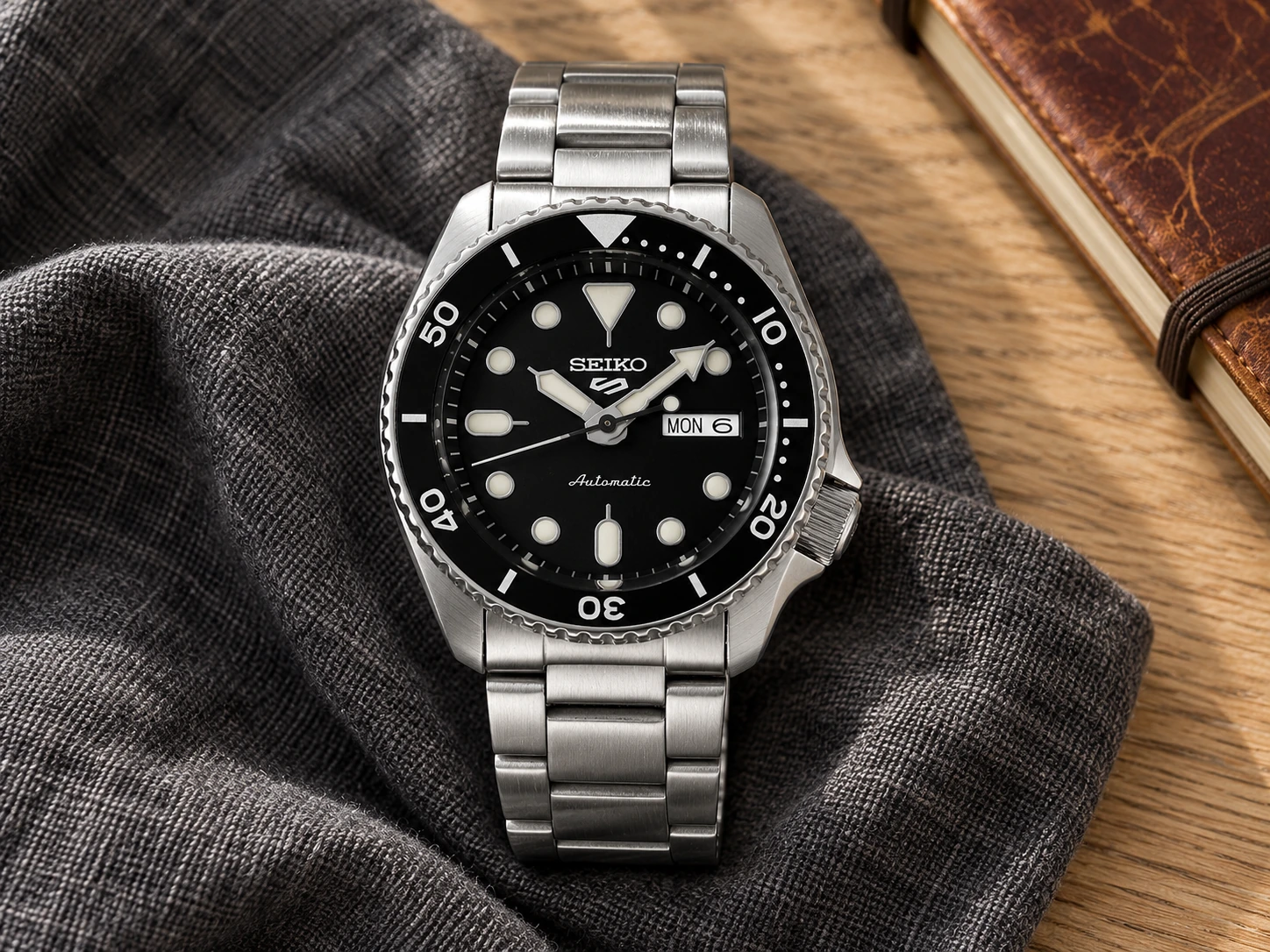
Measure more than diameter. Lug-to-lug length, thickness and bracelet end links influence how the watch occupies your wrist. Seiko's SRPD55 specification gives a 42.5 mm diameter, 46 mm lug-to-lug and 13.4 mm thickness. Those numbers help you compare it with a watch you know; they do not guarantee cuff clearance or comfort on your particular wrist.
Do the same check with a smaller option. Citizen's BM8180-03E has a listed 37 mm case width. It represents a different starting point, not a universal answer. A compact watch can still have a strap you dislike, and a larger case can feel comfortable if its shape suits you. Buy the overall fit rather than the size label.
3. Decide how much attention the watch should attract
A versatile watch usually has a visual language that repeats something in your clothes. A dark dial can sit easily alongside charcoal, navy or black. Brushed steel can feel less conspicuous than highly reflective surfaces. A green fabric strap can work with earthy casual clothing. These are helpful relationships, not requirements to match every buckle and button in your wardrobe.
Consider the amount of detail on the dial. A simple display may be easier to combine with different outfits, while a busy bezel or bold case can become a deliberate feature. Neither is wrong. The question is whether you want an accessory that quietly belongs or one that leads the outfit. If you are buying your only watch, that distinction deserves an honest answer.
Photographs often distort this decision. A large close-up makes every watch seem like the center of attention. Step back from the screen and imagine the object at normal wrist distance, partly covered by a sleeve. Look at the whole outfit rather than a cropped hand. If possible, ask someone to take an ordinary standing photograph instead of a dramatic wrist shot.
Avoid buying a watch to impress an imagined group of enthusiasts if you do not share their preferences. Most colleagues will notice whether you look comfortable and put together, not the movement inside the case. A watch that fits your own style is easier to wear consistently than a technically impressive model that feels like a costume whenever you leave the house.
4. Choose a routine you can keep on Monday morning
An automatic can be enjoyable if setting and winding are part of the appeal. It can also stop after a period without wear. If you put it down on Friday and need it ready for an early Monday train, check whether that routine suits its power reserve and your actual use. A winder is not automatically necessary, and buying one should not be the default solution to disliking the routine.
Quartz removes winding from the equation but still needs battery service at intervals. Light-powered quartz adds a charging routine instead of ordinary battery replacement, although rechargeable components can eventually need service. If you keep a watch in a drawer between uses, read the charging and storage instructions carefully. Office lighting and time near a window are not interchangeable conditions in every manual.
For someone who wears one analog watch regularly and wants fewer daily tasks, the Citizen field-watch route deserves a look. For someone who enjoys mechanical ownership, the Seiko route may feel more rewarding. If you want compact digital timekeeping with familiar styling, consider a model such as the Casio A158WA-1, after checking its display and fit in person if possible.
Do not use “daily watch” as a promise of never needing attention. Any watch can need adjustment, cleaning or service. Instead, choose the kind of attention you accept. That makes the purchase more satisfying because the ownership experience will resemble what you expected, rather than becoming a surprise after the return window closes.
5. Treat straps as a practical choice, not a disguise
A strap changes how a watch feels and looks, but it cannot erase the case. Putting leather on a large sports watch does not make it thin, and a fabric strap cannot reduce the diameter. Before budgeting for alternatives, decide whether you like the watch in its supplied configuration. You should not need three extra purchases to make your first purchase tolerable.
Metal bracelets can be useful across casual outfits, but proper sizing matters. Check whether the clasp and adjustment range work for your wrist, and allow for professional sizing if needed. Fabric straps can feel relaxed and easy to coordinate, yet they can absorb moisture and need drying. Leather has its own care limitations. Match the material to your routine rather than assuming one is universally best.
If you plan to change straps, confirm the lug width and attachment design. Check whether tools or special end pieces are needed. Consider whether the replacement is suitable for the activities you intend. A strap failure is not just a cosmetic problem. If you are unsure about fitment, a competent watchmaker is a better route than forcing a spring bar into place.
For a work-and-weekend setup, start with one comfortable strap or bracelet. Add a second only when it solves a specific problem, such as a wet fabric strap after an approved activity or a different level of formality for occasional meetings. That keeps the total cost clear and avoids turning a simple one-watch plan into an accessory collection you did not want.
6. Compare four routes, with reasons to pass
The Citizen BM8180-03E is a field-style option for someone who wants analog time and light-powered ownership. Its casual green strap may work well with denim and relaxed office clothes. Pass if your work requires a more formal appearance, if the strap does not suit your comfort needs, or if you cannot maintain the recommended charging routine. Do not assume its styling becomes formal simply because it is analog.
The Casio A158WA-1 is a different direction: a compact-looking digital design with a silver-tone bracelet appearance. It can suit a relaxed office and casual weekends without the setting routine of an automatic. Pass if the display is too small for your eyes or the bracelet fit bothers you. The model name matters; similar Casios can have different dimensions, finishes or functions.
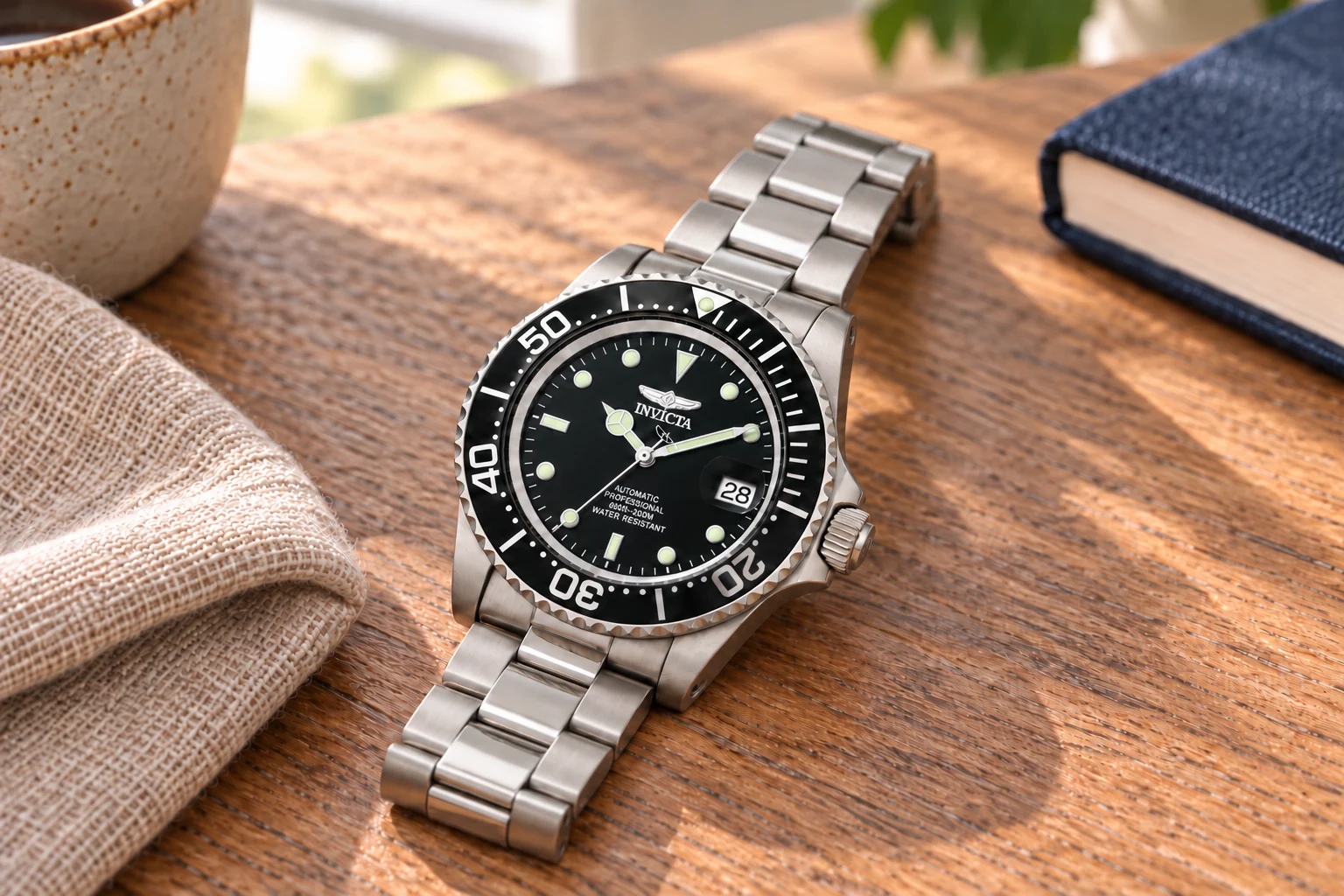
The Seiko SRPD55 is the mechanical sports route. It makes sense if you like its black dial and steel bracelet and have checked its case dimensions against your wrist and sleeves. Pass if the thickness interferes with your work clothes or you want quartz-like convenience without resetting. A familiar brand and attractive case cannot remove those tradeoffs.
The Casio G-SHOCK GA-2100-1A1 is the more visibly casual direction. Consider it when its style fits your workplace and activities, and check the actual analog-digital display in your usual light. Pass if the low-contrast all-black appearance is difficult for you to read or if a resin sports watch conflicts with your dress code. None of these four routes wins every category; their differences make the choice useful.
7. Build three outfits before you buy
Lay out one normal work outfit, one more polished work outfit and one weekend outfit. Put the candidate watch beside them on screen, or try it with similar clothes in a store. You are looking for compatibility with what you already own. If you suddenly need different shoes, a new belt and another jacket, the watch may be leading you away from a useful everyday purchase.
For a relaxed workday, dark trousers, a plain shirt and clean shoes can give a sports or field watch enough context. For a more polished day, cuff fit and restraint may matter more than a feature list. For a weekend, the same watch can work with denim and a sweatshirt if its comfort and care requirements still suit the activity. The exact outfit depends on your workplace and climate.
Do not make color matching complicated. Repeat one or two tones rather than trying to synchronize every material. A black dial does not require an entirely black wardrobe. A green strap can act as a quiet accent. If you prefer one watch, a color you already wear regularly is usually easier to integrate than a dramatic color chosen only because it looked good in a product photograph.
Take notes on what fails. Perhaps the watch catches a fitted cuff, or a highly reflective bracelet feels too dressy with your everyday clothes. Those observations are more actionable than a vague feeling that you need a “better” watch. Our casual office wardrobe guide uses the same approach: identify the real mismatch, then change one thing at a time.
8. Keep the purchase and ownership budget honest
Set a delivered-price ceiling that includes tax, delivery and any required bracelet adjustment. Add a replacement strap only if you already know why you need it. Leave room for future service without inventing a universal maintenance price. If a watch stretches the budget, find out the likely service arrangements before deciding that the initial discount makes it affordable.
Compare the exact reference across clear offers. Model families can include visually similar variants with different cases, movements or bracelets. Confirm the code in the listing and selected cart variant, the seller, product condition and regional warranty terms. Our Amazon search links can show multiple offers and unrelated items; they are a starting point for checking, not a guarantee about the first result.
Read reviews for the issues that affect this particular use. Search within them for cuff fit, clasp, strap, readability or setting. Look for detailed observations from owners of the same variant rather than a general star average. Separate seller problems from design complaints. We do not treat reviews as controlled measurements, and we do not claim a model has the highest conversion rate just because it appears popular.
Finally, ignore artificial urgency. A watch that meets your brief will still be the right kind of watch after a countdown banner ends. If the offer is unclear or the total cost is uncomfortable, wait. Choosing one watch for a whole week is an exercise in reducing friction. The purchase itself should not become the most stressful part of that plan.
9. Know when one watch is the wrong goal
One watch can cover a lot, but it does not have to cover every situation. A workplace with safety restrictions, a formal event or a specialist water activity may need a different approach. Removing the watch is sometimes the right answer. Keeping an inexpensive separate option for a specific task can also be more sensible than forcing one costly watch into incompatible roles.
If your only watch spends the day being taken off and put back on, identify why. The issue might be a case that is too thick, an uncomfortable clasp, a strap that stays damp or a display that is hard to read. Fixing the specific issue is more effective than assuming you need a more prestigious brand. Price does not change the shape of your wrist or the cut of your sleeve.
Give a new watch a fair indoor trial within the seller's return conditions. Check ordinary movement and clothing before removing links, exposing it to water or discarding packaging. Learn the setting and care instructions. If you decide to keep it, record the reference and service information somewhere you can find later. That is more useful than saving another collection photograph.
The successful result is fairly quiet: you put the watch on, it works with your clothes, and you get on with the day. If it also makes you smile when you check the time, that is a good reason to enjoy it. You do not need a universal winner. You need a watch whose compromises fit the week you actually live.
Before you decide
Common questions
Can I wear a digital watch to work?
Often, in a casual workplace, but the actual dress code decides. Check visibility, comfort and whether accessories are restricted for safety or hygiene. A price or brand name does not override workplace requirements.
Does a bracelet make a sports watch formal?
A bracelet can change the appearance, but case shape, thickness and dial still matter. Try the watch with your actual cuff and office clothes instead of assuming a material change solves every mismatch.
Is one watch enough?
It can be, when your activities and dress requirements are compatible. It is also sensible to remove a watch or use a separate suitable option for a task that needs different equipment.
Featured in this guide
The next good question
Keep exploring.
 Read the story ↗
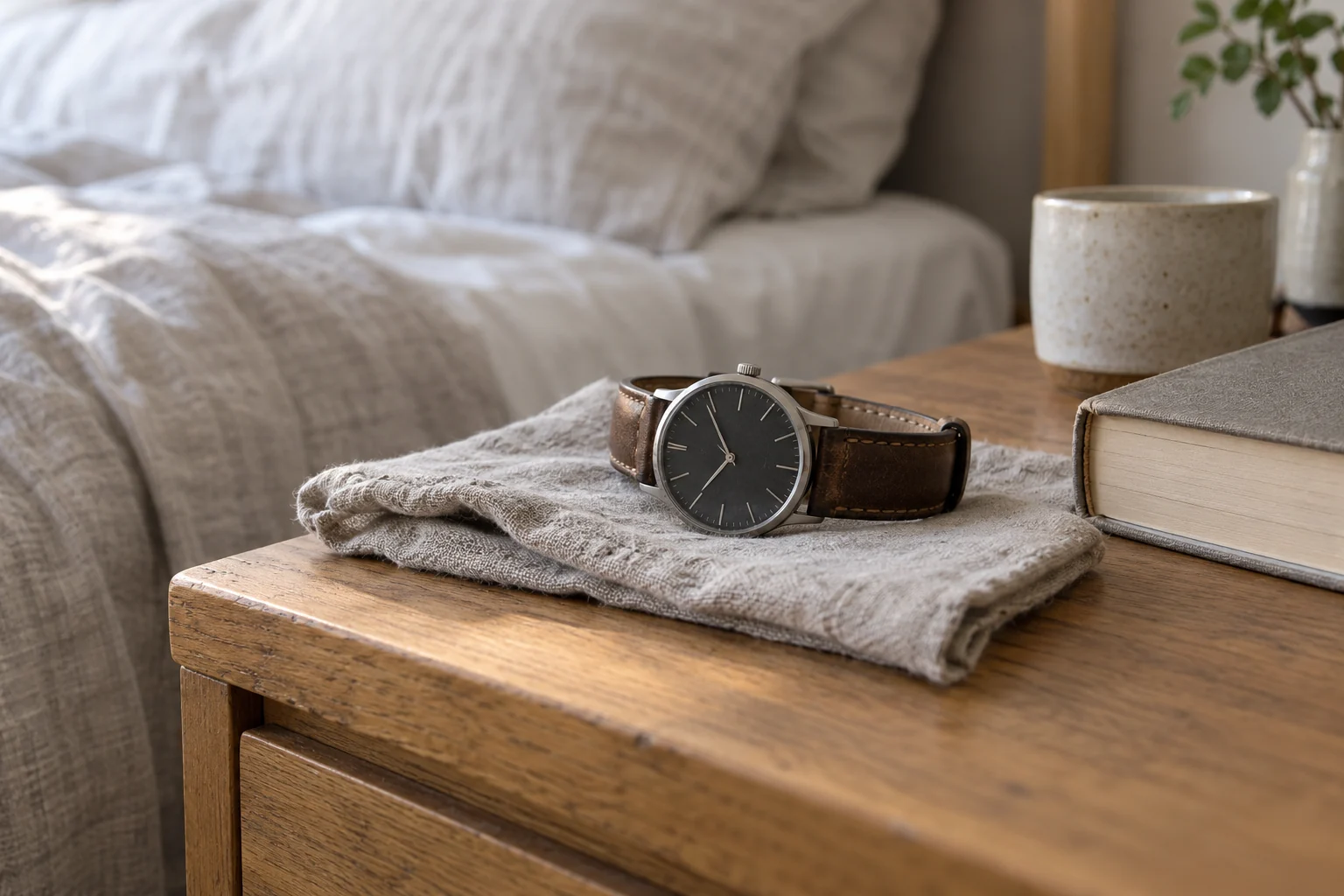
Why Does My Automatic Watch Stop Overnight? A Practical Checklist
A quiet day can leave less energy than you expect. Start with a controlled observation before buying a winder or assuming the movement is broken.
 Read the story ↗
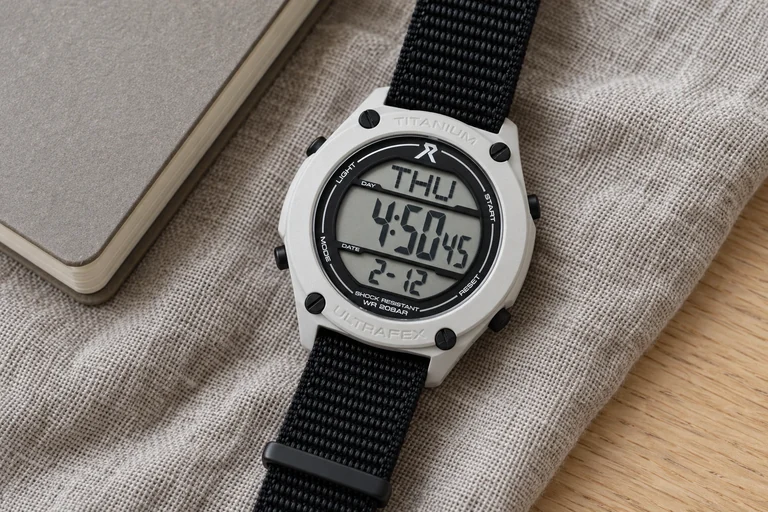
RZE UTD-8080: A Small Digital Watch Story With a Big Question
The interesting part is not another countdown timer. It is the idea that a newer watch need not make your older one obsolete.
 Read the story ↗
Best Automatic Watches Under $200: A Budget-Honest Buying Guide
A smaller shortlist. A complete bill. A watch you will actually wear.