Style & wardrobe / A closer look
Do Cotton Hoodies Shrink? How to Check Fit and Reduce Further Shrinkage
A tighter fit can come from a real size change, measurement differences or the way the hoodie is sitting. Find out which before trying to stretch it back.
Start here
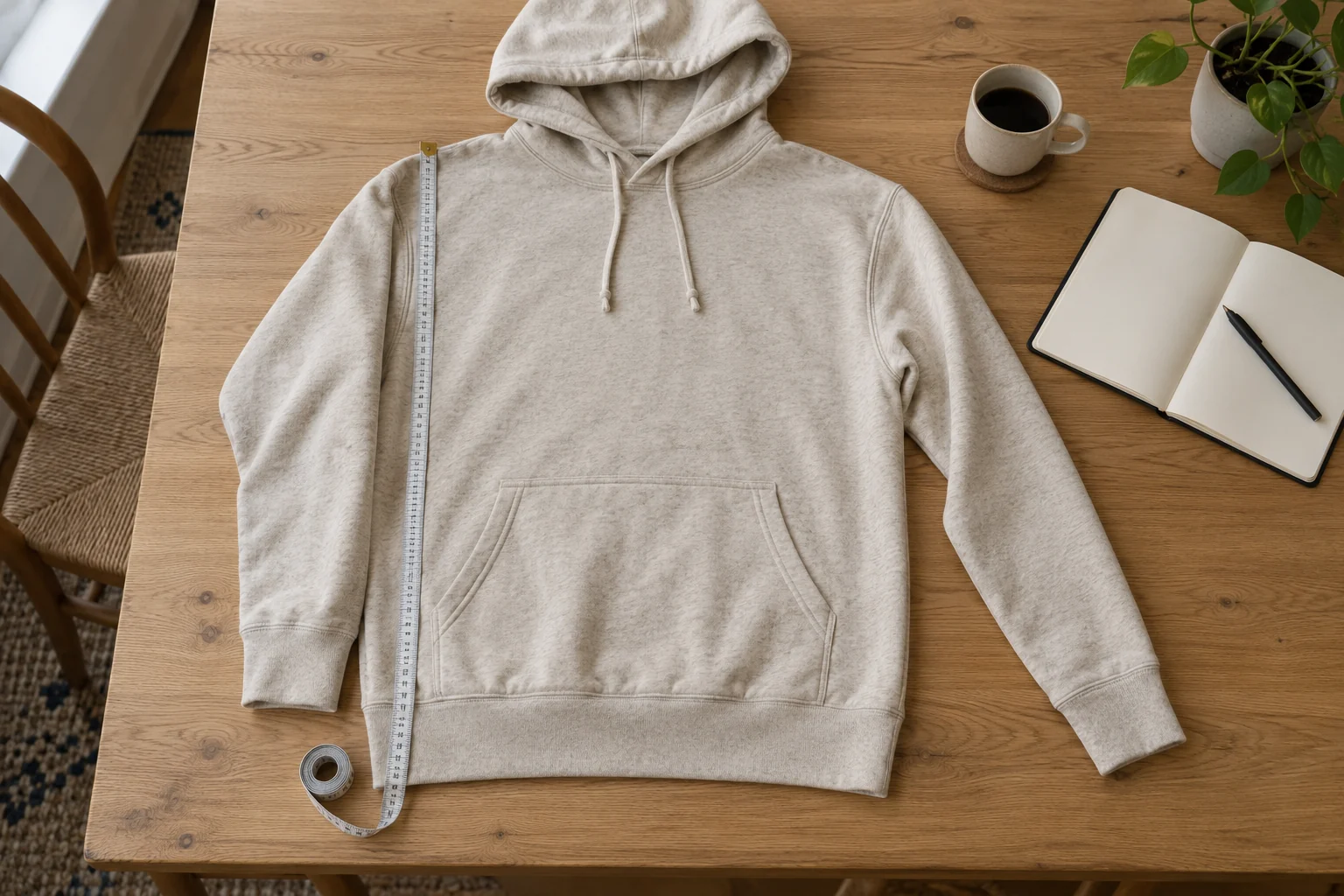
Cotton hoodies can change dimensions after washing and drying, but the amount depends on the fabric, construction, finishing and care conditions. “Preshrunk” is not a promise of zero change. Follow the garment’s care label and compare the same dry, relaxed measurement points before and after care. Measure length and width separately; do not assume a fixed shrinkage percentage for every cotton hoodie.
As an Amazon Associate, we earn from qualifying purchases. How our links work ↗
1. Cotton content alone does not predict the change
Two hoodies labeled cotton can behave differently. Their knit structure, yarn, finishing and manufacturing tension may differ, as can the way the finished garments were prepared before sale. A thick hand feel is not evidence that the dimensions will stay fixed. Likewise, adding another fiber does not establish a universal shrinkage percentage.
CottonWorks' technical shrinkage handout describes production variables such as stitch length, tension and finishing. That is useful context for why a single care shortcut cannot predict every garment. Its industrial discussion is not a home washing recipe or a guarantee for a particular hoodie.
Read the complete garment label: fiber percentages, care instructions and any special treatment of trims or prints. If “preshrunk” appears in the listing, ask whether the retailer states a measured dimensional tolerance and under which care conditions. Without that information, treat the word as a manufacturing description rather than permission to ignore the care label.
2. Measure a dry, relaxed hoodie before changing anything
Lay the hoodie on a flat surface large enough to support the body. Smooth obvious folds gently without stretching the fabric. Keep the hem and shoulders resting naturally. Use the same tape and units for every observation. A damp or freshly stretched garment does not provide a comparable baseline for one measured fully dry.
Choose repeatable points. For body length, record the exact starting point and whether you measured down the front or back. For chest width, note the distance below the underarm and measure straight across. Measure sleeve length using the same path each time, especially with dropped shoulders or raglan sleeves. Photograph the endpoints so you can reproduce them later.
Do not compare a body chest circumference with a laid-flat garment width. Do not measure one sleeve from the shoulder seam and the next from the neckline. These errors can look like shrinkage. If you need a clearer explanation of chart methods, our T-shirt measuring guide shows why the retailer's definitions matter.
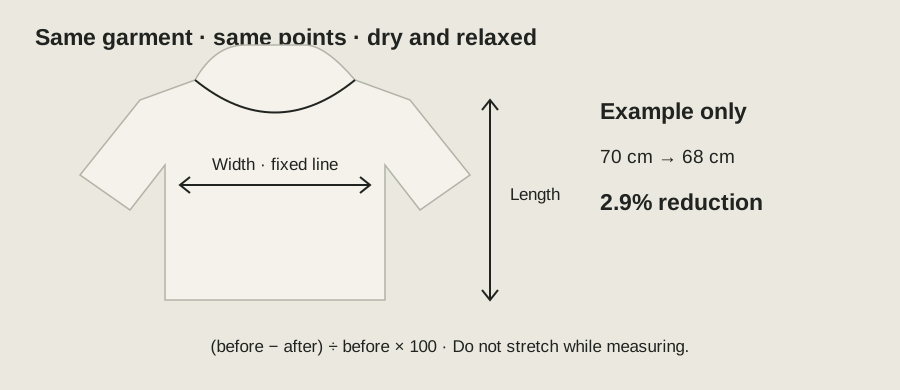
3. Calculate length and width changes separately
Use this formula for each dimension: (before − after) ÷ before × 100. In an arithmetic example, a length of 70 centimeters becomes 68 centimeters: the reduction is about 2.9 percent. A width of 60 centimeters becomes 59 centimeters: the reduction is about 1.7 percent. These are teaching examples, not test results or expectations for cotton clothing.
The calculator below performs that arithmetic using two positive measurements in the same units. A negative answer means the later measurement is larger. That can reflect expansion, measuring differences or an inconsistent resting state; it does not prove a specific fabric mechanism. Record the original figures rather than reporting only the rounded percentage.
If repeating the measurement changes the result noticeably, improve your technique before interpreting it. Check that the tape is straight, the garment is dry and the chosen points match the first photograph. Small changes should be read alongside measurement uncertainty. This home worksheet is not a standardized textile laboratory test.
Dimensional-change calculator
Use two positive measurements in the same units, for one dimension at a time.
Calculate a dimensional change
Use these checks alongside the detailed steps. Checkmarks last only for this open page.
Download checklist · TXT4. Choose washing and drying from the actual care label
The care label is the starting constraint for temperature, washing method and drying. A cotton body may share a garment with a print, lining or trim that needs different treatment. Use a routine permitted for the entire garment. If the label is missing, look for instructions for the exact model or ask the maker before experimenting.
The American Cleaning Institute's laundry basics emphasizes reading care instructions and sorting accordingly. Keep a record of the program, drying method and whether the hoodie was fully dry before measuring. A named program such as “delicates” is not necessarily the same across machines.
If the label allows air drying, support the garment as instructed and avoid hanging a heavy wet knit in a way that pulls it out of shape. If it allows tumble drying, follow the stated setting. Do not assume that switching to one care method can reverse a size change that has already occurred. The practical goal is a consistent permitted routine and a fit you can continue wearing.
5. If it already feels smaller, separate fit from restoration
First compare the dry measurements with your baseline. If you have no earlier record, compare carefully with the retailer's measurement method and tolerance, while recognizing that a different sample is not your hoodie's original size. Also check whether a stiff hand feel, a folded hem or a newly layered shirt is changing how it wears.
Do not start with forceful stretching, high heat or a household “unshrinking” mixture. There is no universal method here that promises to restore cotton hoodies to their original dimensions without affecting seams, prints or shape. Ask the manufacturer whether it recommends any reshaping while damp for that specific garment.
If the hoodie changed substantially after care that followed its label, document the routine and measurements and contact the retailer. Include photographs of the label and the same measurement points. Ask about assessment rather than declaring a manufacturing defect from a single feeling of tightness. Keep the garment available in its current condition while the seller responds.
6. Use your record for the next purchase
A well-fitting washed hoodie makes a better size reference than a new one whose care behavior you have not observed. Save its length, width and sleeve measurements together with the fabric composition and your routine. When shopping, compare them with the seller's actual garment measurements, not the size letter alone.
Ask whether the size chart describes the garment before care, after a stated wash or simply a production target. If the seller cannot clarify, allow for that uncertainty rather than choosing a precise shrinkage correction yourself. Buying one size larger to compensate for a guessed percentage can leave the shoulders, hood and sleeves wrong.
Decide which dimension matters most for your use. A shorter body may expose the waist when you reach, while a reduced chest width may affect layering. A slightly different sleeve length may be tolerable. Your record lets you make that decision explicitly instead of replacing every hoodie with the same larger size.
For a shared household routine, attach a short note to the garment's storage or laundry area: the permitted wash method, drying instruction and the date of your last measurement. This makes the experiment reproducible if someone else does the laundry. Recheck only when the fit changes or the care routine changes; measuring after every wear is unnecessary.
Questions readers ask
Does preshrunk mean a hoodie cannot shrink?
No. Ask about the garment’s stated tolerance and care conditions. The term alone does not promise zero dimensional change.
Should I use one shrinkage percentage for chest and length?
No. Measure each dimension separately using the same dry, relaxed method.
Can the calculator tell whether my hoodie is defective?
No. It calculates a dimensional change only. Care conditions, measuring uncertainty and the seller’s specifications still matter.
Sources and how this guide was prepared
This is a researched explanation and a practical owner checklist. We reviewed the official sources below on October 5, 2026; we have not performed a laboratory test or claimed firsthand ownership of every device discussed. Worked examples and conceptual diagrams are labeled. Workspace and wearing scenes provide context; use model documentation for specifications and fit. Check the manual and support guidance for your exact model.
- CottonWorks: shrinkage variables and dimensional stability
- American Cleaning Institute: laundry basics
Found a model-specific exception or an instruction that has changed? Use the site's contact information and include the model and official source so the guide can be corrected.
Continue with the relevant guide
The next good question
Keep exploring.
 Read the story ↗
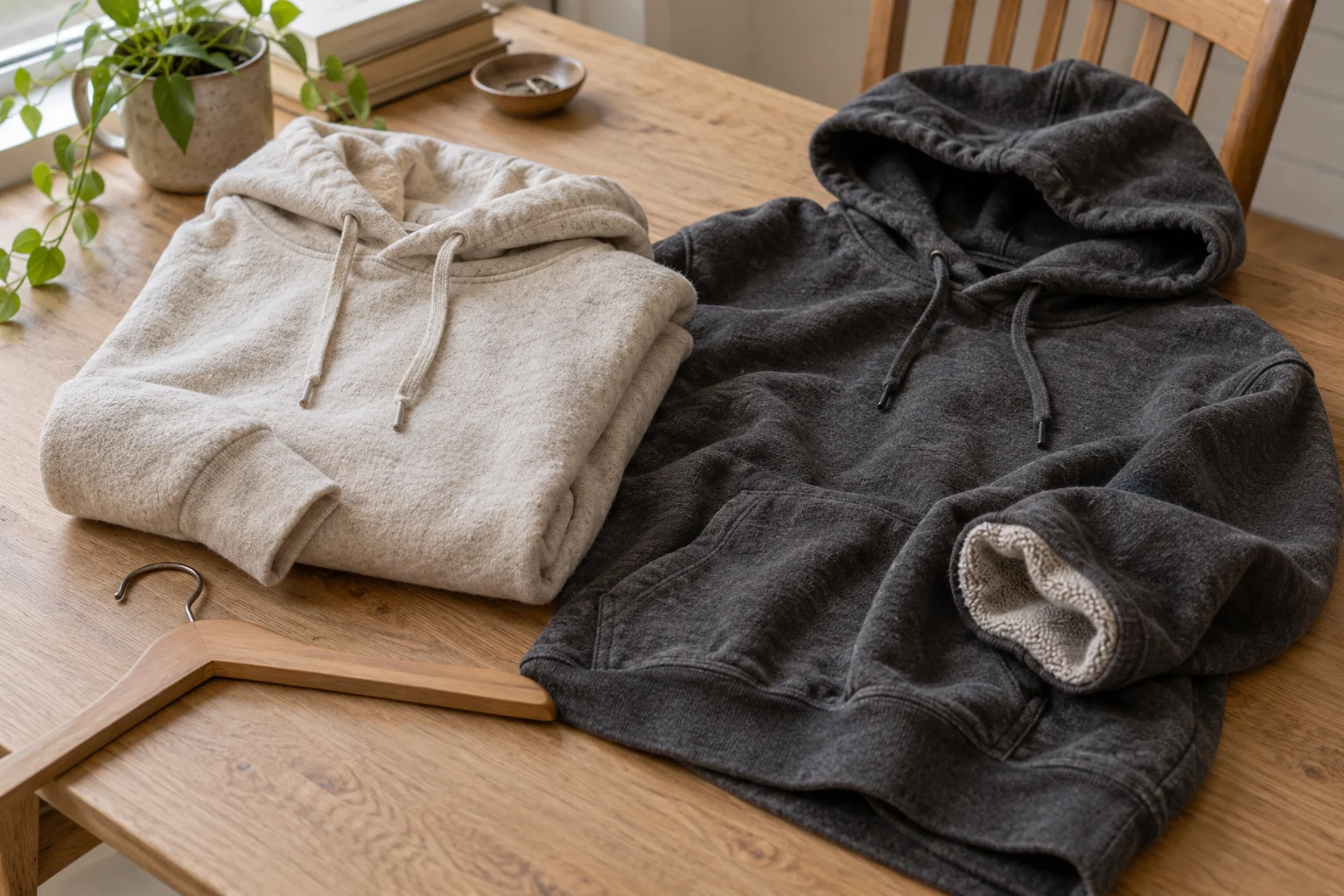
Cotton vs Cotton-Polyester Hoodies: Fabric, Drying and Everyday Use
The composition label is useful information. It is not a complete forecast of comfort, drying time or how the hoodie will wear.
 Read the story ↗
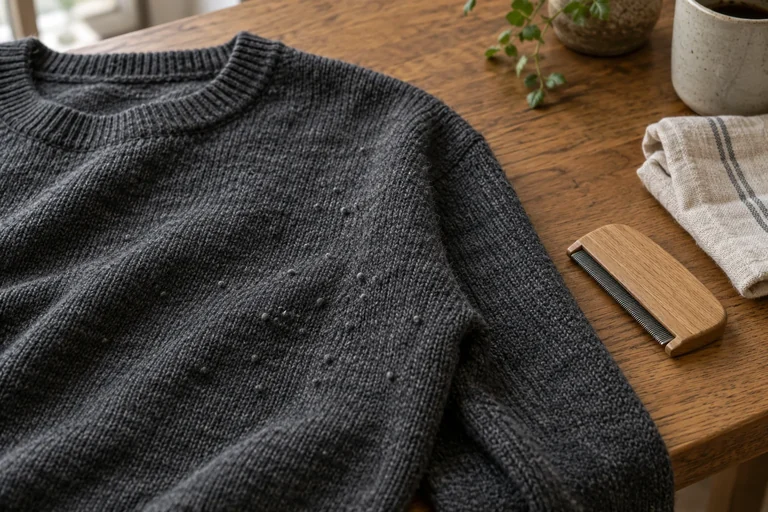
How to Remove Pilling from Hoodies and Sweaters Without Damaging the Fabric
Start with the fabric, not the sharpest tool. A small local trial gives you more useful information than shaving the entire garment at once.
 Read the story ↗
Best Heavyweight T-Shirts Under $40: Fabric, Fit and Value Guide
A heavyweight T-shirt can drape cleanly and feel substantial, but GSM alone does not guarantee quality or comfort. Under $40, compare fabric weight, cotton type, shrinkage guidance, collar construction, fit measurements and return policy. Choose a shirt that suits your climate and layering habits rather than treating the thickest fabric as automatically best.