Style & wardrobe / A closer look
Jeans or Work Pants for the Office? A Fit-First Buying Guide
A neat trouser that feels wrong after ten minutes is not a good office buy. Start with how you sit, move and dress, then choose the fabric.
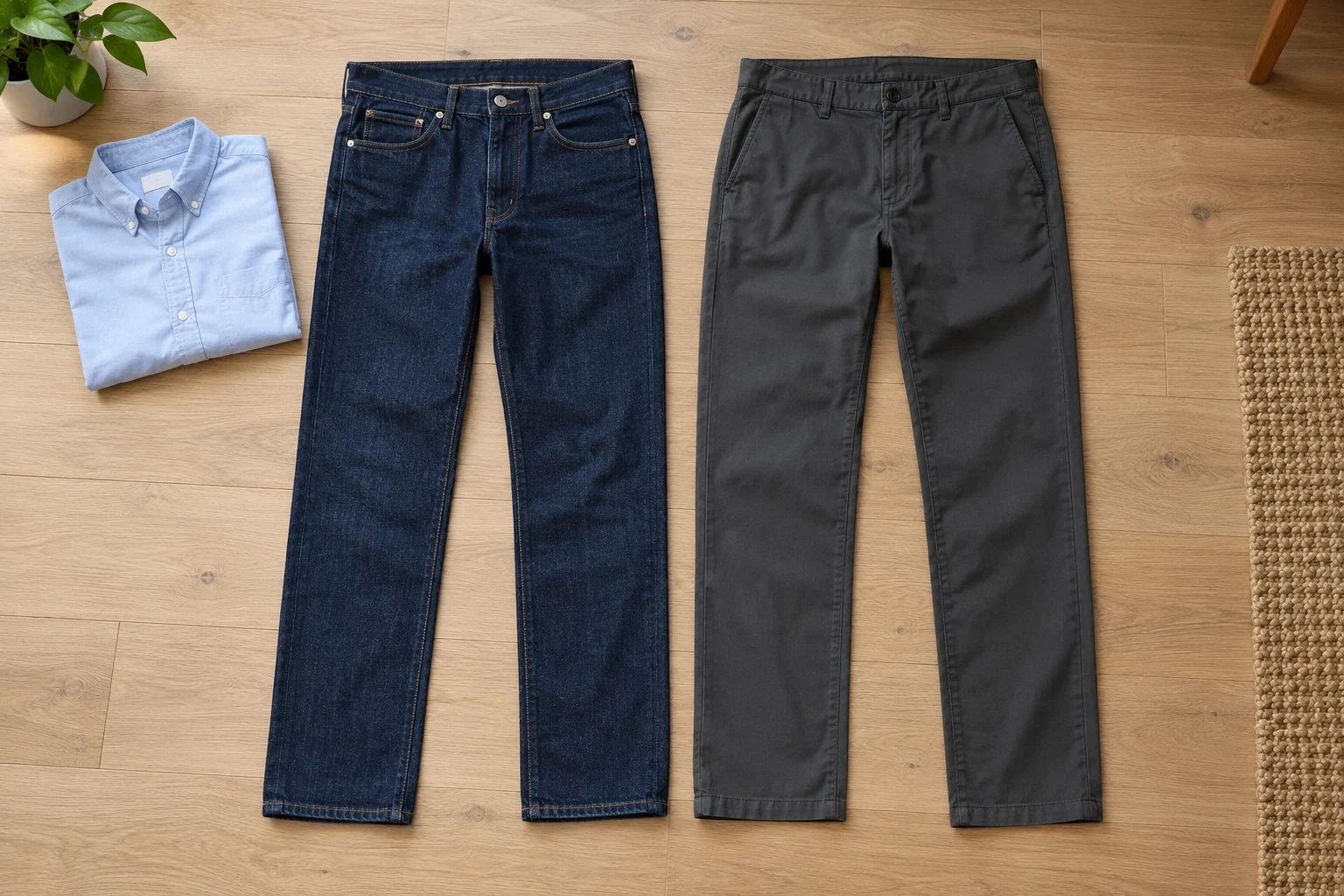
Start here
The useful answer
As an Amazon Associate, we earn from qualifying purchases. How our links work ↗
The useful answer
Choose jeans or work pants by dress code and fit before fabric reputation. Check waist, rise, seat and thigh room while seated, then judge leg shape and hem with your actual shoes. Dark, non-distressed denim can work where permitted; work pants offer another visual direction but are not automatically more formal or comfortable. Compare the exact variant and care label.
Compare the buying routes ↓| Choose by this question | Jeans route | Work-pants route |
|---|---|---|
| Does the office permit it? | Confirm denim and finish rules | Confirm the style fits the dress code |
| How does it feel seated? | Check rise, seat and thigh in the exact cut | Check the same points; workwear naming proves nothing |
| What shape do you want? | Compare straight and slim cuts separately | Inspect leg shape, pockets and hem |
| How will you care for it? | Follow the selected wash’s label | Follow the exact fabric and finish label |
Jeans and work pants can both make sense in a casual office. They can also both become an uncomfortable purchase if you choose them from a standing product photograph and ignore the hours you spend sitting. The useful question is not which category is inherently better. It is which particular pair fits your body, workplace and week.
This guide compares the decision rather than declaring a winner. We use Levi's 501 Original, Levi's 511 Slim and Dickies 874 as recognizable starting points, with exact-reference checks before purchase. We have not worn every variant or measured every size. Fabric, wash and construction can change within a familiar model family, so the selected listing and care label remain important.
1. Decide whether denim belongs in your office
Start with the actual dress code. Some offices permit dark jeans but not distressed finishes; others allow denim only on certain days. Some expect trousers for client-facing work regardless of what colleagues wear at their desks. Check the written policy and the expectations for your role. A neat-looking product photograph is not proof that the garment belongs in every workplace.
If denim is permitted, inspect the finish you are considering. Fading, contrast stitching, pocket details and distressing all affect how casual a pair appears. Dark denim can be easier to combine with a plain shirt, but color alone does not turn jeans into formal trousers. The rest of the outfit and the workplace context still matter.
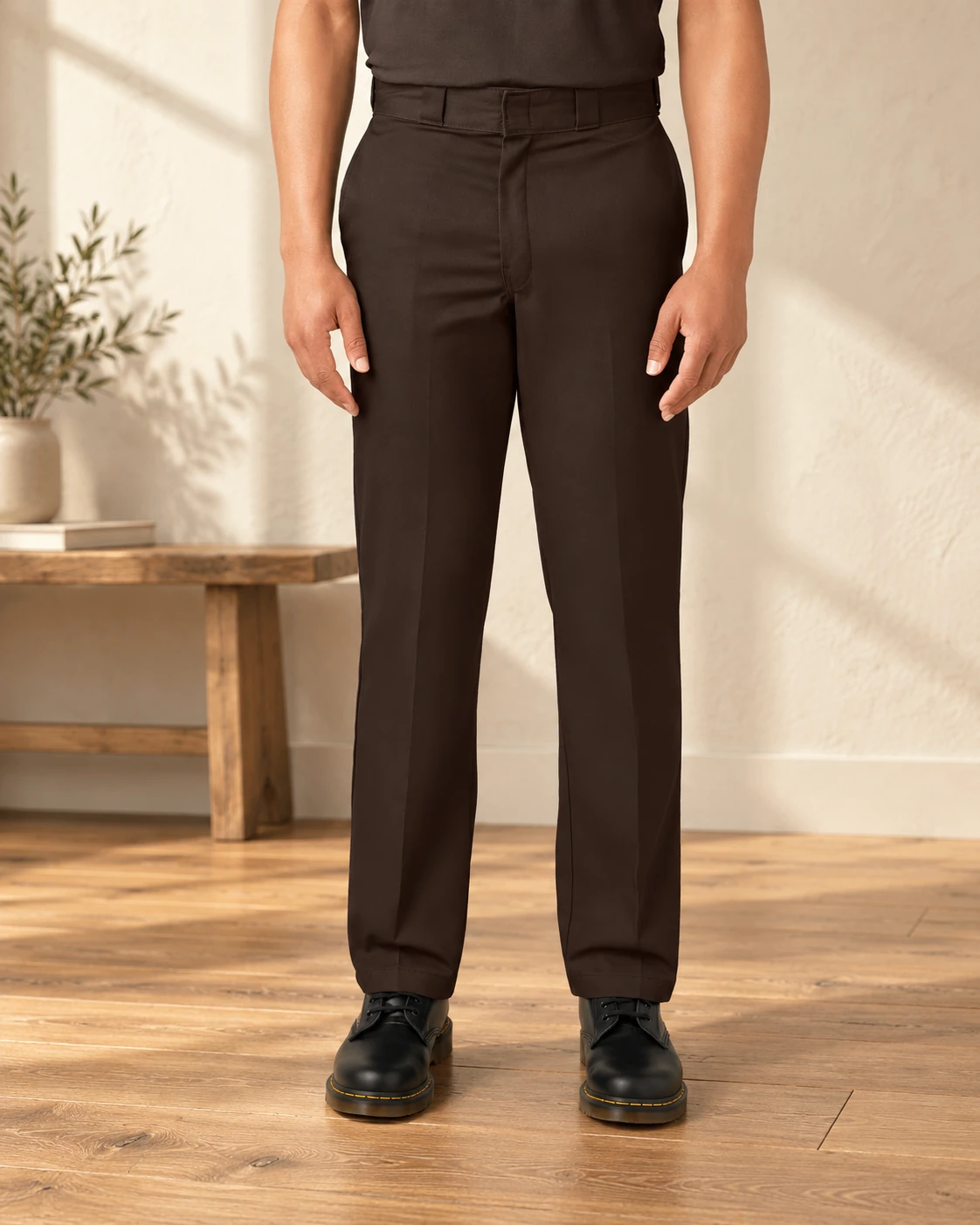
Work pants are not automatically formal either. A sturdy twill trouser may have a clear workwear appearance, substantial fabric or distinctive pockets. That can be useful in a relaxed office and wrong in another setting. “Work” in a product name does not establish suitability for your profession, and ordinary workwear is not necessarily protective equipment for a regulated task.
Write a simple boundary before shopping: for example, “plain dark bottoms, no distressing, comfortable with a tucked shirt and approved shoes.” If your office needs formal trousers, use that requirement instead of trying to force jeans or work pants into the role. A buying guide should help you reject the wrong category as readily as choose a product within it.
2. Separate fit from fabric and brand
Fit describes the space and shape around your body. Fabric describes the material and construction. A brand or model name can suggest a direction, but it does not replace either check. A straight-leg jean can feel restrictive at the thigh, while a slimmer pair in a different cut can feel comfortable. The label is a starting point, not a verdict.
Compare a pair you already like. Lay it flat without stretching, fasten it and record the measurements that help you: waistband, front rise, thigh width, inseam and hem opening. Use the same method when comparing finished-garment measurements. If the seller supplies a body-size chart instead, follow its instructions rather than treating it as a flat garment chart.
Notice where your existing pair succeeds or fails. If the waist is fine but the thighs pull, ordering a larger waist may create a new problem. If the seat sags while the waistband feels tight, you may need a different cut or rise. Naming the fit issue is more useful than deciding that a whole brand “does not fit” from one unsuitable model.
Keep fabric preferences separate while you test. You may like the appearance of rigid denim but prefer some elasticity for a long commute. You may like the structure of twill but dislike the feel of one particular blend. Those preferences are valid. The goal is a pair you will wear comfortably, not proving that one material has more credibility online.
3. Test the waist and rise while seated
Put the trousers on where you naturally intend to wear the waistband. Fasten them without using a belt to force the fit. Sit on an ordinary chair, stand again and bend as you would during the day. Check for pressure at the waist and pulling through the front. A pair that only feels comfortable while standing still has not passed an office fit check.
Rise affects where the waistband sits and how the garment moves around your body. A different rise can change comfort even when the tagged waist is the same. Do not assume a lower or higher rise is universally better. Consider your torso, how you wear shirts and the position in which you spend most of your workday.
Add the shirt you normally tuck in, if that is part of the outfit. A waistband that feels acceptable over a tee may feel cramped with a tucked shirt. Conversely, adding excessive room to accommodate a bulky layer can make the garment unstable. Test the real combination rather than guessing how much space a future outfit will need.
Treat a belt as an accessory and minor adjustment, not a repair for a fundamentally wrong cut. If tightening it creates large folds or distorts the pockets, reconsider the size or shape. If the waistband gaps while the seat and thighs fit, ask whether an alteration is practical and cost-effective. Do not assume every mismatch can be solved neatly after purchase.
4. Check the seat, thigh and knee in motion
Walk, sit, climb a step if safe, and reach down as you normally would. Watch for pulling across the pockets, pressure through the thighs or a seat that restricts movement. You do not need exaggerated acrobatics to test office trousers, but a few ordinary movements are much more informative than a single front-facing mirror pose.
Look at the pockets while standing naturally. If they flare or the fabric pulls sharply around them, the cut or size may not suit you. Some folds are normal; the aim is not a perfectly smooth mannequin finish. You are checking whether the garment has enough room to work with your body without constant adjustment or an uncomfortable waistband shift.
Stretch can improve flexibility in some constructions, but it does not make an unsuitable pattern correct. A tight trouser with elasticity can still feel restrictive or place pressure where you do not want it. Equally, a non-stretch pair with sufficient room can be comfortable. Read the actual fabric composition and test the shape rather than treating “stretch” as an automatic comfort guarantee.
If the thigh fits but the lower leg feels too wide, you may need a different leg shape rather than a smaller size. If you like a straight silhouette, allow it to be straight instead of sizing down until it behaves like a slim cut. Buying the intended shape in a suitable size is usually more useful than trying to remake one style into another through discomfort.
5. Judge the leg and hem with your actual shoes
Put on the shoes you wear to work before deciding on trouser length. A hem behaves differently over a low shoe, a boot or a bulkier sole. Check the front and side views, then walk a little. Excess fabric can bunch at the ankle, while a shorter length can expose more sock when seated. Neither is universally wrong; choose the result that suits the office and your preference.
Leg opening influences how the trousers sit over footwear. A narrow opening may catch on a boot, while a wider straight leg may fall differently. Do not judge the whole fit by the hem alone. A pair can have a pleasing ankle shape and still be uncomfortable through the seat. Work from the top of the garment downward before deciding whether the final silhouette works.
If hemming is needed, include the alteration cost in the budget and understand the seller's return conditions before making changes. A simple hem can be a reasonable adjustment. Changing rise, seat or the entire leg is a different project. Ask a competent tailor what is possible rather than assuming an inexpensive pair remains inexpensive after major alteration.
Consider the complete outfit in an ordinary full-length photograph. A shirt's length, the trouser rise and the shoe shape interact. Product photographs often isolate one garment in a flattering pose, so they cannot show that relationship for your body. Your own reference photo can make the decision clearer without turning it into an elaborate style exercise.
6. Understand the fabric you are actually buying
Denim is not one fixed material. The chosen wash, weight, fiber blend and finish affect how a pair feels and how it should be cared for. A familiar fit name can appear in several fabric versions. Read the exact selected reference rather than borrowing composition details from another color or an older review. “Same model family” is not always the same fabric.
Twill work pants also vary. A particular blend or finish can give a structured appearance, but that does not establish warmth, breathability or comfort for every wearer. If you spend the day in a heated office, an especially substantial fabric may be less useful than you expect. If your commute is cold, the complete outfit and conditions still matter more than the category name.
Avoid assuming that heavier means better. Weight can affect drape and feel, but durability also depends on construction, use and care. A garment that is too warm or stiff for your day may remain unused regardless of how impressive its description sounds. Choose a fabric you can live with and maintain, then judge value from actual use rather than a single number.
Our selvedge versus stretch denim guide explains another common confusion: construction details and elasticity are separate questions. You do not need to collect specialized fabric terminology to buy office jeans. You need enough accurate information to know the selected pair's fit, care requirements and likely role in your wardrobe.
7. Compare three real directions without forcing a winner
Levi's 501 Original in Dark Stonewash, reference 005010194, is a straight-leg route to investigate. Consider it if you want that silhouette and the selected fit works through your waist, seat and thighs. Pass if the rise or shape does not suit your body. A long-established model name is not a substitute for trying the actual size.
Levi's 511 Slim in Throttle, reference 045111163, is the slimmer direction in this comparison. It may make sense if you prefer a closer line and can move comfortably in the selected version. Pass if the thigh or seat feels restrictive. Do not size down merely to create a sharper outline; that can undermine the reason you need a pair for long workdays.
The Dickies 874 offers a work-trouser direction rather than another denim cut. Check the full variant and current size information on the brand page and actual offer. Consider it when its shape, fabric and appearance suit your relaxed office. Pass if you need formal tailoring, a different rise or a fabric that feels more comfortable in your environment.
These options illustrate three questions: do you want straight denim, slimmer denim or a work-pant appearance? They are not a verified sales ranking or a claim that all three cost the same. Keep a suitable existing pair if it already meets the brief. Buy a new one only when it fills a clear fit, care or dress-code gap that your current clothes cannot cover.
8. Plan care before calling something an everyday basic
Read the care label for the actual pair. Do not assume every jean can be washed and dried identically, or that every work trouser keeps its dimensions under any routine. Fabric blends, finishes and construction vary. If you need a low-maintenance work rotation, the care instructions are part of the buying decision rather than a detail to discover after the first wash.
Compare the trousers with your laundry schedule. A pair that takes longer to dry than your routine allows may need an alternative in the rotation. If pressing is required for the appearance you want, decide whether you will realistically do it. There is no virtue in building a small wardrobe around maintenance tasks you consistently avoid. A slightly different fabric or another useful pair may be more practical.
Do not plan to correct a poor fit through uncontrolled shrinkage. Changes from washing can be uneven and may affect length, width and appearance differently. If you are concerned, record measurements before care and follow the label. For a new purchase, understand the return terms before washing or altering it. A deliberate fit check is more reliable than hoping laundry will tailor the garment.
Look after small repairs while they are still small. A loose button, worn seam or damaged pocket can take an otherwise useful pair out of rotation. Where repair is practical, keeping a good-fitting garment in use can be better value than replacing it. An everyday basic earns that description by working over time, not simply by being sold in several neutral colors.
9. Run a final offer and arrival checklist
Before ordering, confirm the exact model, wash or color, waist, inseam and fabric version. Check the seller, condition, delivered total and return policy. Our Amazon links may open model-specific searches with other products mixed in. Match the reference on the listing and selected cart variant. A familiar photograph or abbreviated title is not enough to establish that it is the intended pair.
Use reviews to investigate specific fit questions, not to outsource your size choice. Look for the same model and variant, and read the context of comments about rise, thigh room or fabric feel. Body proportions and preferences differ. A reviewer saying “perfect fit” provides little information without measurements or a description of what they wanted. Treat reviews as prompts for checking, not a universal size chart.
When the trousers arrive, keep tags and packaging while you repeat the seated and movement checks within the seller's conditions. Try the intended shirt and shoes. Compare the result with your original brief. If the waist, rise or thigh feels wrong, do not keep the pair solely because the hem looks good or the sale seemed too attractive to miss.
The better choice is the pair you can wear through an ordinary workday without repeatedly thinking about it. That might be denim, twill or a different trouser category altogether. Use the fit process to narrow the field, choose a clear offer and let the product label remain secondary to the way the garment actually works for you.
Before you decide
Common questions
Are dark jeans more professional than work pants?
Neither category wins automatically. The office dress code, finish, fit, condition and complete outfit decide. Dark jeans can suit a casual office, while a workwear trouser can still look too casual for a formal role.
Should I size up slim jeans for more thigh room?
Compare measurements and try the cut before assuming a larger waist solves it. A different fit may provide the required thigh and seat room without creating an oversized waistband.
Can washing fix trousers that are too large?
It is not a reliable tailoring method. Dimensional changes vary and can affect different areas unevenly. Choose a suitable fit, follow the actual care label and consider appropriate alterations only after understanding the cost and return implications.
Featured in this guide
The next good question
Keep exploring.
 Read the story ↗
A Minimalist Outfit Under $150: A Practical Budget and Fit Plan
Plan a simple outfit around a $150 delivered budget. Start with clothing you own, allocate the remaining cost and check exact sizes, fabric and seller terms.
 Read the story ↗
A Casual Office Capsule Wardrobe: Five Outfits Without Overbuying
Five workdays do not need five separate wardrobes. Build a few compatible combinations that fit the job, the commute and your body.
 Read the story ↗
How to Keep Black Clothes from Fading: A Care-Label-First Routine
Before adding a new laundry product, find out whether you are seeing lost color, a surface deposit or loose fibers.