Watches / A closer look
Best G-SHOCK Square for Everyday Wear: DW-5600BB or GW-M5610U?
The square has lasted because it knows its job. Choosing your version is less about collecting features and more about reading the time.
Start here
The useful answer
As an Amazon Associate, we earn from qualifying purchases. How our links work ↗
The useful answer
Investigate the DW-5600BB if the all-black design is the priority and you accept a negative display. Consider the GW-M5610U for a positive display, solar charging and radio adjustment in supported conditions. Try the display and buttons before deciding.
| Priority | Start here | Check first |
|---|---|---|
| Muted black appearance | DW-5600BB | Negative-LCD readability in your lighting |
| Solar ownership | GW-M5610U | Charging instructions and ordinary light exposure |
| Radio adjustment | GW-M5610U | Supported regions and local reception |
| Simple time display at a lower budget | W-800H alternative | Different case, functions and protection specification |
The square G-SHOCK is an unusual success story. It can look like a small piece of equipment that escaped from a workshop, yet it fits quite happily beside a laptop and a coffee. It is recognizable without needing polished metal or a complicated dial. After enough exposure to watch launches, that clarity starts to feel like a luxury of its own.
The difficult part is choosing a square. Similar outlines hide different displays, power systems and adjustment features. For an everyday buyer, two especially distinct routes are the all-black DW-5600BB and the solar GW-M5610U. This is a researched guide to their different ownership ideas, with a little history to explain why the shape still matters. It is not a claim that we have performed impact or water tests.
A design born from a problem
Casio dates the first G-SHOCK, the DW-5000C, to 1983. Its account describes a pursuit of shock resistance and a protected module inside the case. The important historical point is that the form followed a job. The shape was not simply a decorative attempt to look technical; protection was part of the original design brief.
That history helps explain the appeal without requiring every modern wearer to lead an adventurous life. A clearly purposeful object can be enjoyable at a desk. You do not have to invent a mountain expedition to appreciate it. The better question is whether that purposeful design makes ordinary timekeeping more convenient for you, or whether you mainly like how it looks. Both answers can justify interest.
Why the square survives a phone in every pocket
A phone is a better general-purpose information device than a basic watch. It is also a much more distracting place to ask a very small question. Checking the time can become checking a notification, then a message, then something you did not intend to open. A conventional digital watch keeps that transaction narrow. You look, you know, and you carry on.
This is not a claim that everyone should use a watch to improve focus. It is a description of the appeal. The square can sit beside a modern connected routine without trying to become another screen full of obligations. If you want health tracking or communication features, assess devices designed for those jobs. If you mainly want time and a few simple tools, more connectivity may be unnecessary.
The DW-5600BB is a visual choice with a practical consequence
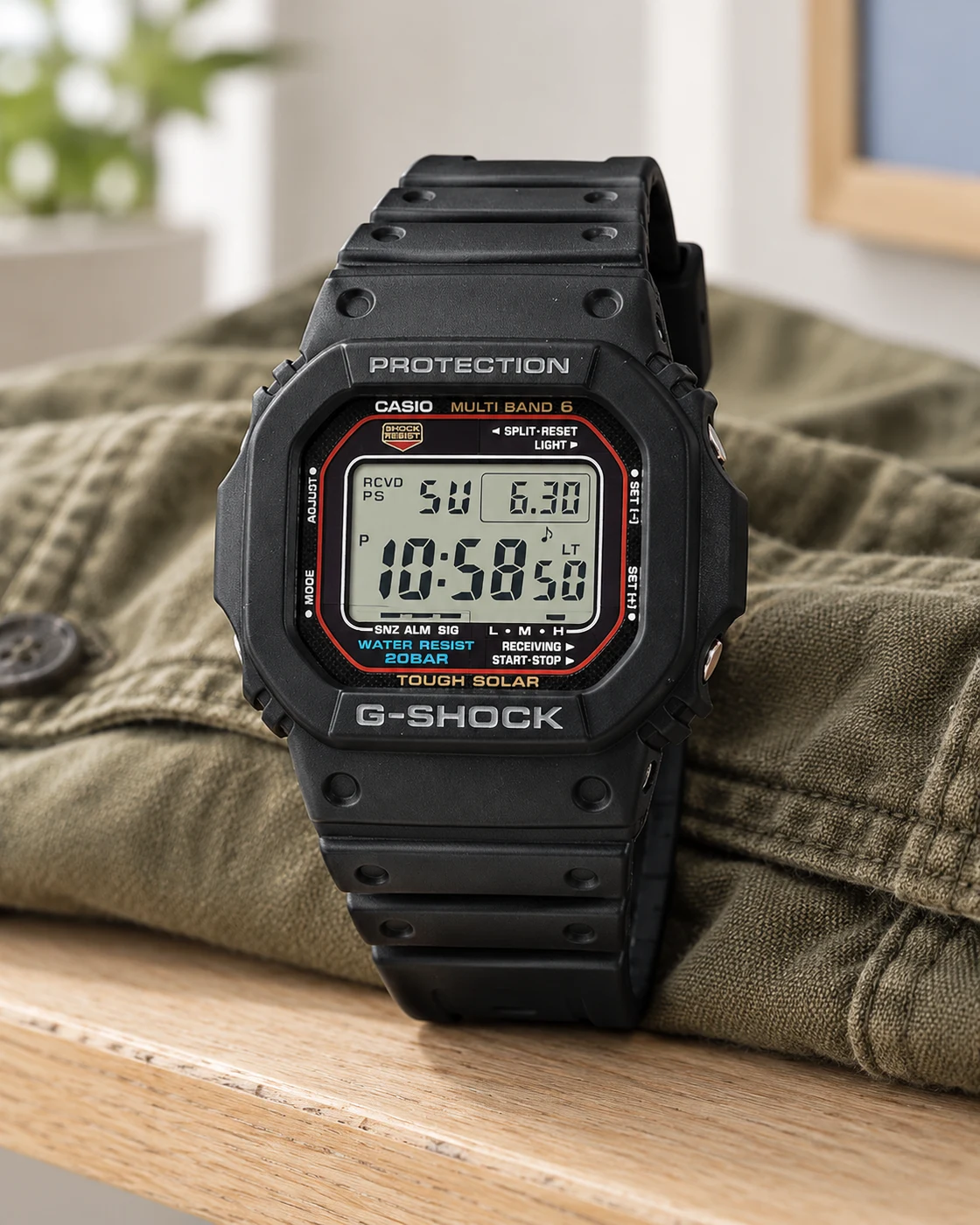
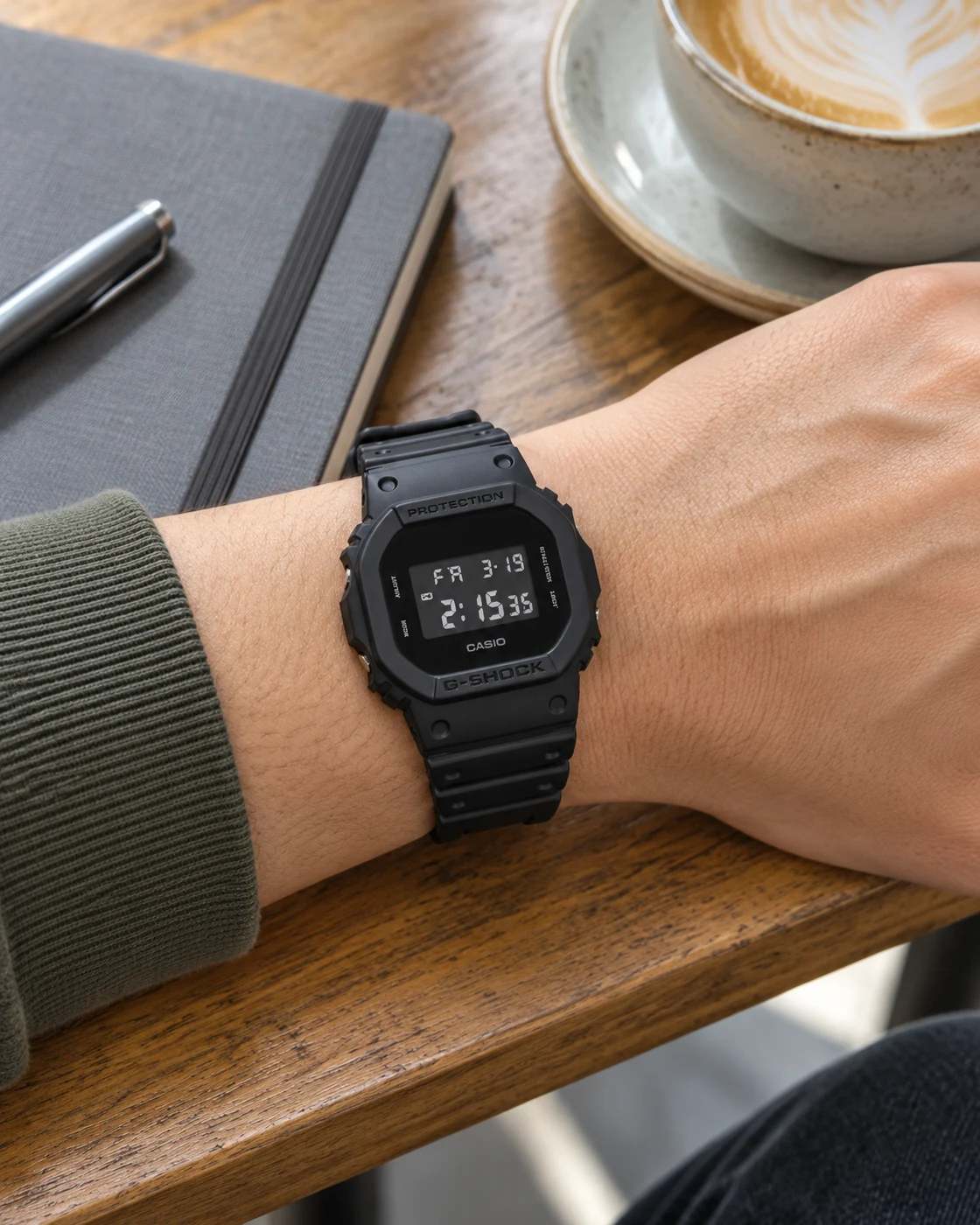
The DW-5600BB model page presents the deliberately blacked-out square. The selected Shop listing is the DW-5600BB-1CR with a negative LCD. That dark appearance is the reason many buyers will investigate it. It is also why you should think carefully about the display instead of judging the watch from its silhouette alone.
Negative displays can be attractive in photographs, especially when the case and strap form one quiet shape. Your wrist is not a photographic setup. You may glance from an angle, indoors or while carrying something. Try to see the actual display in conditions close to your own. If you need to rotate your wrist repeatedly to read it, decide whether you will still enjoy that compromise six months from now.
The GW-M5610U makes a different bargain
Casio lists the GW-M5610U with Tough Solar, Multi Band 6 radio adjustment, a positive display, 200 m water resistance, mineral glass and a resin construction. The stated case dimensions are 46.7 by 43.2 by 12.7 mm. These are model specifications rather than our measurements. The Japan-market 1JF listing also needs its own import and warranty check.
The attraction is a time-focused routine with fewer reasons to interact with the watch once it is configured appropriately. That does not mean no maintenance and no conditions. Solar charging needs adequate light, and radio adjustment needs suitable reception. A feature that works well in one owner’s location may be less useful in another. Buy the function for the conditions in which you will actually use it.
Positive and negative displays deserve an ordinary-light test
Do not begin with the brightest possible backlight photograph. Begin with a normal glance. Can you read the main time without pausing? Are smaller labels useful to you? What happens when a sleeve casts a shadow? If you usually wear glasses, use the same glasses during the comparison. A display is a personal interface, not only a component specification.
When shopping remotely, look for varied images and read comments that describe a situation rather than simply declaring the display good or bad. A person who mostly wears a watch outdoors may have a different experience from someone in a dim office. Neither observation has to be dishonest. The useful review tells you enough about the conditions to decide whether it applies to your life.
Solar power changes a routine; it does not remove responsibility
A light-powered watch can be appealing if you dislike thinking about ordinary battery changes. The ownership habit shifts toward keeping it sufficiently exposed to appropriate light. Someone who wears the same watch regularly has a different routine from someone who stores several watches in a dark box and rotates them infrequently. That difference should be considered before buying on the strength of the word solar.
Read the charging guidance for the exact module. Avoid making up your own heat-intensive charging method or assuming that every light source behaves the same way. If the watch arrives with a low charge, follow the instructions instead of immediately treating the condition as a fault. The practical benefit comes from a routine that suits the product, not from ignoring its requirements.
Radio adjustment is useful without being magical
The phrase radio-controlled can sound as though accurate setup happens automatically everywhere. Actual reception depends on location and conditions. Buildings, interference and the way the watch is placed can matter. The important buying question is whether the feature is likely to be useful where you live and travel, not whether it appears impressive in a list of features.
Before buying for this function, consult the model manual’s supported regions and reception guidance. Learn the manual-setting process too. A watch that has not synchronized is not necessarily broken, and a feature that works at home may behave differently on a trip. Understanding this beforehand makes the watch less mysterious and stops a useful convenience from becoming an unrealistic expectation.
A square number is not a round-watch diameter
Case measurements for a square watch can confuse shoppers used to a single diameter. Width, length and thickness describe different parts of the fit. The strap also begins curving away from the case in a particular way. A photograph centered on a wrist can hide that curve, while an extreme close-up can exaggerate the whole watch.
Measure the flat top of your wrist and compare with a watch you already wear comfortably. Look for images taken at normal viewing distance, then inspect how the strap meets the wrist rather than only where the case ends. If possible, try it with a jacket cuff. The best fit is the one that feels unremarkable after the first few minutes, not necessarily the one with the smallest specification.
Buttons are part of the interface too
Digital watches can offer plenty of functions while asking you to remember a small button language. A timer is only convenient if you can find and set it when you need it. Think about how often you will use anything beyond the main time display. An occasional traveler may interact with settings differently from someone who times repeated tasks throughout a workday.
Read enough of the manual before buying to understand the sequence for your two most important functions. If you can try the watch, operate those functions yourself rather than watching a salesperson do it. This is not a test of your ability to become a watch expert. It is a chance to find out whether the interface matches the amount of attention you want to give it.
Tough does not mean careless
The G-SHOCK identity can make people talk as though ordinary care no longer applies. A durable design still has a strap, seals, controls and manufacturer instructions. Do not turn promotional toughness into permission to perform an unnecessary stunt. A watch can be appropriate for demanding use without needing you to recreate an advertisement in your kitchen.
For water use, follow the specific model’s guidance and consider the condition of the actual watch. For cleaning, use the recommended method rather than whatever chemical happens to be nearby. Check the strap and attachment points periodically. These are simple ownership habits. They protect the object you bought to avoid fuss, which is more sensible than discovering how far a dramatic slogan can be stretched.
The cheaper alternative is worth naming
Some readers do not need the square G-SHOCK story at all. They want a clear digital time display for a modest amount of money. The Casio W-800H is included in our Shop as a different route to investigate. It is not the same construction or feature set, and it should not be presented as one. It may still fit a simpler brief.
Start by writing the job in one sentence. If it says, “I want to see the time without charging a smartwatch,” do not assume that you need every extra feature discussed here. If it says, “I have always liked the square G-SHOCK and want one I can keep wearing,” the design itself is part of the value. A good shortlist leaves room for both kinds of buyer.
Import listings and almost-identical names
The final letters in a reference can reflect market packaging or regional distribution, and listings may combine several names. Do not assume that an import automatically has the same local warranty arrangement as a domestic purchase. Check who is selling, what is included and what happens if the product arrives with a problem.
Keep the exact reference from the selected offer and compare it with the manufacturer’s model information. Be particularly careful about confusing the DW-5600BB with other 5600 references or the GW-M5610U with similarly named earlier models. A familiar photograph can conceal a different display or module. The task is not to memorize the entire range; it is to confirm the one watch you are about to buy.
A five-question shortlist
Ask whether you can read it comfortably, whether it fits under your normal cuff, whether you will use the extra functions, whether the power routine suits you and whether the seller’s terms are clear. Answer those before ranking styling details. If one answer is uncertain, identify how you will resolve it: a manual, a store visit, a seller question or a more suitable alternative.
Then wait a day before returning to the product photographs. If the all-black square still appeals and you accept the display tradeoff, the BB has a clear reason to stay on the list. If the positive display and solar routine are what you want, investigate the GW-M5610U. Neither answer needs to become a universal statement about the best watch for everyone.
Build a small routine around the functions you keep
After buying a digital watch, choose the two or three functions you genuinely want to remember. Set the main time correctly, learn the light control and practice the timer or alarm if those matter to your day. You do not need to master every mode on the first evening. A familiar limited routine is more useful than periodically rediscovering a long list of features you never use.
Keep the module instructions somewhere easy to find. A bookmarked manual can save time when you travel or need to change a setting months later. If you share a watch with somebody else, show the basic controls rather than assuming the interface is obvious. A digital that feels uncomplicated to an experienced owner can still be confusing to a new one.
Then judge the purchase after ordinary use. Are you reading the display easily, choosing the watch without hesitation and using the functions you expected? If so, the decision is working even if another reference has more features. If not, identify the specific obstacle before buying a second square. The best next step might be learning one setting, changing the fit or choosing a more readable version, rather than collecting another nearly identical case.
The best square is the one you stop thinking about
An everyday watch succeeds when it becomes easy to live with. That might be the dark, visually quiet BB or the more feature-focused GW-M5610U. It might also be a simpler digital outside the G-SHOCK family. The right choice is the one whose strengths matter in your routine and whose compromises you understand before paying.
Use the cards below to inspect the selected versions and current retailer offers. Keep the manual, set the watch carefully and give yourself time to learn the functions you actually need. The square’s long story is interesting, but its daily job remains wonderfully small: be there when you glance at your wrist, and make the answer easy to find.
The questions worth asking
Before you decide.
Is the DW-5600BB solar powered?
Do not confuse it with the GW-M5610U. The all-black BB listing is a different model and should be checked against its own module instructions.
Will Multi Band 6 always synchronize?
No. Reception depends on supported locations, surroundings and operating conditions. A radio-controlled watch can still require manual setup.
Is every square G-SHOCK the same size?
No. Check the exact case dimensions, strap and module. A similar outline does not establish an identical fit or feature set.
Featured in this guide
The next good question
Keep exploring.
 Read the story ↗
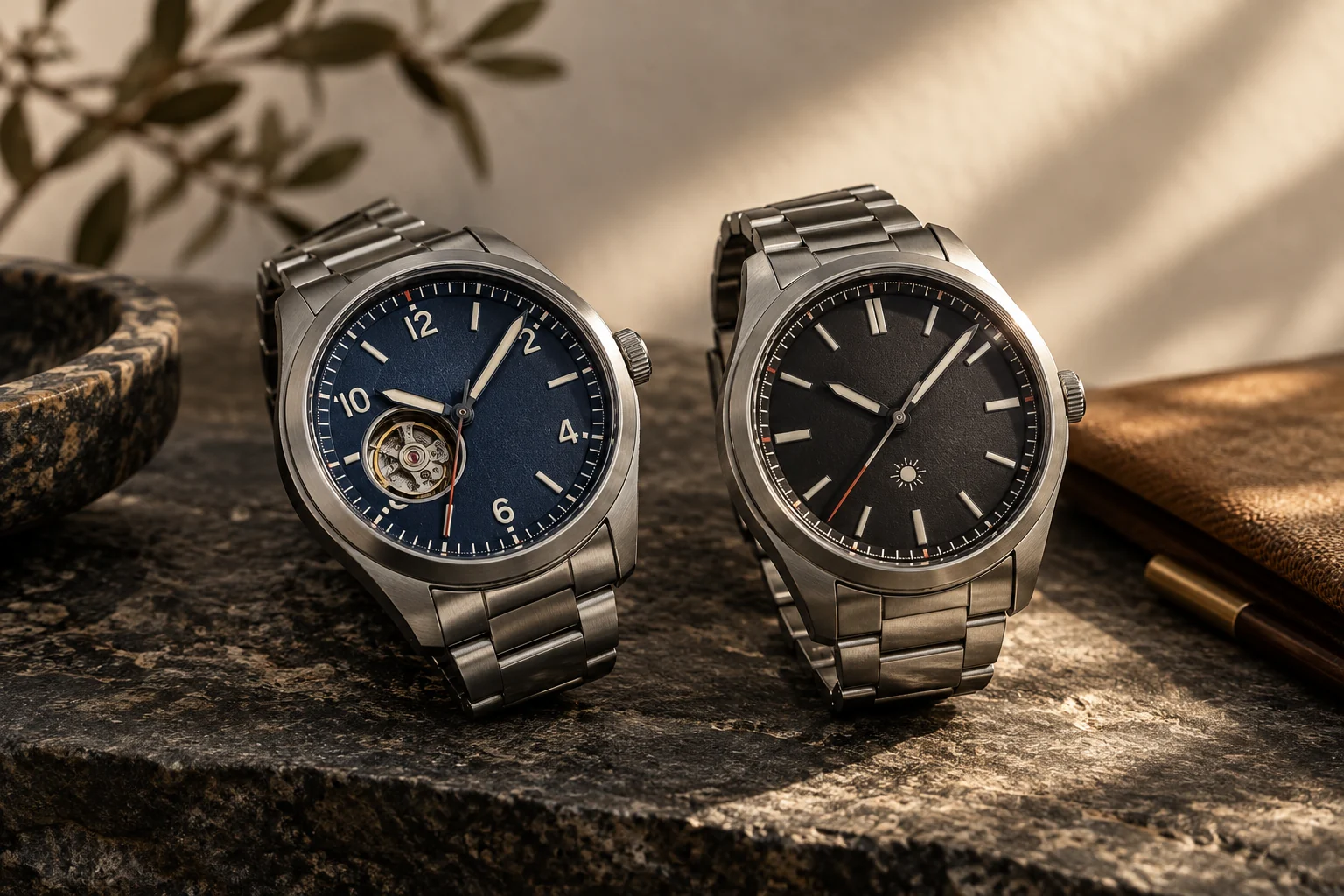
Automatic vs Solar Watch for Everyday Wear: Which Movement Fits Your Life?
A practical movement guide for choosing the charm of an automatic watch or the low-maintenance reliability of a light-powered watch.
 Read the story ↗
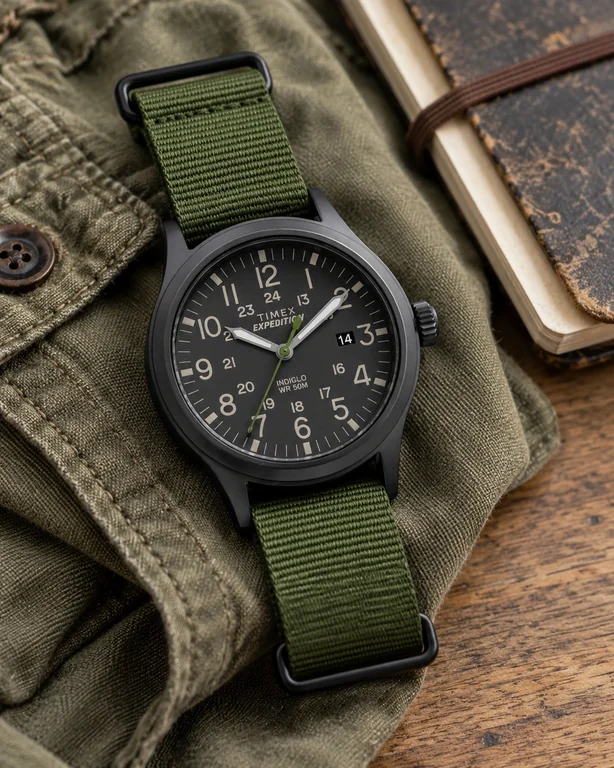
Best Field Watch for Everyday Wear: Why Simple Still Works
A field watch does not need a fictional expedition to earn its place. A busy ordinary day is a demanding enough brief.
 Read the story ↗
How to Choose an Everyday Watch You’ll Actually Wear
Start with your Tuesday, not somebody else’s collection. A practical route from daily routine to a watch that earns its place.